Business Growth

If the Knowledge Lives in Your Team’s Mind, the Business Is Not Yours
Blog, Business Growth

अगर नॉलेज टीम के दिमाग में है तो बिज़नेस आपका नहीं है

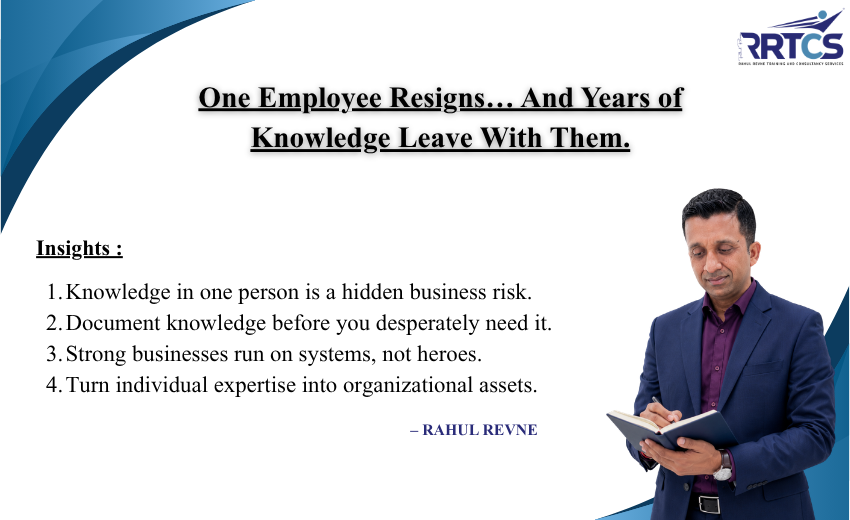
RRTCS  ने अलग-अलग इंडस्ट्री के कई बिज़नेस के साथ काम करते हुए एक पैटर्न बार-बार देखा है।एक सच्चाई हमेशा सामने आती है:अगर आपके बिज़नेस का नॉलेज सिर्फ टीम की मेमोरी में है और डॉक्यूमेंटेड सिस्टम्स में नहीं है, तो बिज़नेस आपका नहीं है — वह एम्प्लॉइज़ का है। हिडन रिस्क: अनडॉक्यूमेंटेड नॉलेज बहुत सारी कंपनियों में यह सिचुएशन होती है: कोई प्रोसेस लिखा हुआ नहीं कोई एसओपी नहीं की क्लाइंट्स कौन हैं और उनका वेटेज क्या है — कोई रिकॉर्ड नहीं क्लाइंट बिहेवियर, प्रेफरेंस या डिसीजन पैटर्न की कोई नोट्स नहीं सप्लायर कम्युनिकेशन हिस्ट्री नहीं सब कुछ मेमोरी और पर्सनल एक्सपीरियंस पर चल रहा होता है।जब तक की पर्सन है, सब स्मूथ लगता है।लेकिन जिस दिन वह नहीं रहता, सिस्टम कोलैप्स हो जाता है। यह बिज़नेस के अंदर एक सिंगल पॉइंट ऑफ फेल्योर क्रिएट करता है। जब की एम्प्लॉई चला जाता है असल रिस्क तब दिखता है जब कोई इम्पॉर्टेंट व्यक्ति: रिज़ाइन कर देता है लॉन्ग लीव पर चला जाता है अचानक अनअवेलेबल हो जाता है अचानक: काम रुक जाता है क्लाइंट्स को रिस्पॉन्स नहीं मिलता फॉलो-अप्स टूट जाते हैं सप्लायर रिलेशन कमजोर हो जाते हैं नई ऑपर्च्युनिटीज मिस हो जाती हैं टीम कन्फ्यूज़ हो जाती है और सबसे बड़ा नुकसान: क्लाइंट ट्रस्ट। उस समय ओनर को समझ आता है: “बिज़नेस सिस्टम पर नहीं, एक पर्सन पर चल रहा था।” खुद से ये 5 स्ट्रैटेजिक सवाल पूछिए अपने सबसे क्रिटिकल एम्प्लॉई के बारे में सोचिए: अगर वह कल से काम बंद कर दे तो क्या होगा? क्या आपको पता है वह अभी किन कामों पर काम कर रहा है? कौन से क्लाइंट्स सीधे उस पर डिपेंडेंट हैं? उसका एक्ज़ैक्ट वर्किंग प्रोसेस क्या है? क्या कोई दूसरा तुरंत उसकी जगह काम संभाल सकता है? अगर इनका आंसर “नो” है,तो आपका बिज़नेस हाई ऑपरेशनल रिस्क में है। पर्सन-डिपेंडेंट बनाम सिस्टम-ड्रिवन बिज़नेस पर्सन-डिपेंडेंट: नॉलेज लोगों के दिमाग में व्यक्ति गया तो काम बंद ओनर स्ट्रेस्ड ग्रोथ लिमिटेड सिस्टम-ड्रिवन: नॉलेज डॉक्यूमेंट्स में काम स्मूथली चलता है ओनर के पास विज़िबिलिटी बिज़नेस स्केलेबल पर्सन-डिपेंडेंट मॉडल बिज़नेस नहीं, एक फ्रैजाइल स्ट्रक्चर है। क्या करना चाहिए? 1. नॉलेज कैप्चर सिस्टम बनाइए अपने की टीम मेंबर्स के साथ बैठकर डॉक्यूमेंट करें: स्टेप-बाय-स्टेप प्रोसेसेस की क्लाइंट लिस्ट + वेटेज क्लाइंट बिहेवियर और कम्युनिकेशन स्टाइल प्राइसिंग लॉजिक नेगोशिएशन अप्रोच कॉमन प्रॉब्लम्स और सॉल्यूशन्स यह सिर्फ डॉक्यूमेंटेशन नहीं है —यह आपका बिज़नेस डीएनए है। 2. हर रिपीट टास्क के लिए एसओपी बनाइए डॉक्यूमेंट करें: सेल्स प्रोसेस क्लाइंट ऑनबोर्डिंग ऑर्डर एक्ज़ीक्यूशन कम्प्लेंट हैंडलिंग पेमेंट फॉलो-अप्स ताकि कोई भी ट्रेन्ड व्यक्ति काम चला सके। 3. क्लाइंट इंटेलिजेंस शीट बनाइए हर की क्लाइंट के लिए लिखें: डिसीजन मेकर कौन है बाइंग ट्रिगर क्या है पेमेंट पैटर्न कम्युनिकेशन प्रेफरेंस लास्ट डिस्कशन समरी इससे रिलेशनशिप किसी एक पर्सन पर डिपेंडेंट नहीं रहती। 4. रोल बैकअप (शैडो सिस्टम) बनाइए हर क्रिटिकल रोल के लिए: प्राइमरी ओनर ट्रेन्ड सेकेंडरी बैकअप एक पर्सन की एब्सेंस से बिज़नेस कभी नहीं रुकना चाहिए। 5. वीकली नॉलेज ट्रांसफर मीटिंग हर हफ्ते 30 मिनट की मीटिंग: कौन क्या काम कर रहा है नई लर्निंग्स नए रिस्क्स नई ऑपर्च्युनिटीज यह फ्यूचर लीडर्स बनाता है और डिपेंडेंसी कम करता है। 6. ओनर-लेवल स्ट्रैटेजिक विज़िबिलिटी ओनर को सब कुछ खुद करने की ज़रूरत नहीं है,लेकिन हर चीज़ की विज़िबिलिटी होनी चाहिए। सिंपल डैशबोर्ड रखें: एक्टिव डील्स की क्लाइंट स्टेटस पेंडिंग पेमेंट्स मेजर ऑपरेशनल रिस्क्स बिज़नेस की सबसे डेंजरस लाइन “डोंट वरी, वह संभाल लेगा।” यही लाइन डिपेंडेंसी बनाती है,और डिपेंडेंसी स्केलेबिलिटी को खत्म कर देती है। आपका असली बिज़नेस एसेट क्या है? आपका ऑफिस, टीम या प्रोडक्ट नहीं।आपका असली एसेट है:डॉक्यूमेंटेड नॉलेज + डिफाइन्ड प्रोसेसेस + स्ट्रक्चर्ड डेटा। जिस दिन आपका बिज़नेस बिना किसी एक पर्सन पर डिपेंड हुए स्मूथली चलेगा,उस दिन आप ऑपरेटर से ओनर बन जाएंगे। फाइनल स्ट्रैटेजिक ट्रुथ अगर नॉलेज टीम के दिमाग में है,तो कंट्रोल आपके पास नहीं है। जब नॉलेज सिस्टम्स और डॉक्यूमेंट्स में आता है,तभी बिज़नेस सच में आपका बनता है।   क्यों RRTCS? RRTCS – Rahul Revane Training & Consultancy Services में हम आंत्रप्रेन्योर्स को प्रॉफिट फ़र्स्ट फ्रेमवर्क लागू करने में मदद करते हैं: ✅ केपीआई-ड्रिवन फ़ाइनेंशियल डैशबोर्ड डिज़ाइन करना✅ प्रॉफिट लीकेज पॉइंट्स पहचानना ✅ एक्सपेंस कंट्रोल के लिए एसओपी बनाना✅ हर निर्णय में टीम को “प्रॉफिट फ़र्स्ट” सोच के लिए ट्रेनिंग देना क्योंकि असली ग्रोथ बड़ी सेल्स से नहीं — बेहतर प्रॉफिट से होती है। 👉 RRTCS के साथ आप सिर्फ़ ज़्यादा कमाते नहीं — आप ज़्यादा बचाते भी हैं।

If the Knowledge Lives in Your Team’s Mind, the Business Is Not Yours
Blog, Business Growth

If the Knowledge Lives in Your Team’s Mind, the Business Is Not Yours

RRTCS has analysed this pattern while working with many businesses across industries, and one critical truth keeps appearing:If your business knowledge exists only in your team’s memory and not in documented systems, you don’t own the business — your employees do. The Hidden Risk: Undocumented Knowledge In many companies: No processes are written No SOPs exist No record of key clients and their importance No notes on client behaviour, preferences, or decision patterns No supplier communication history Everything runs on memory and personal experience.It works — until the day it doesn’t. This creates a single point of failure inside the business. The Moment a Key Employee Leaves The real risk becomes visible when one key person: resigns goes on long leave becomes unavailable Suddenly: Work stops Clients don’t get responses Follow-ups break Supplier relationships weaken New opportunities are lost The team becomes confused And the most dangerous loss: client trust. At that moment the owner realizes: “The business was not running on a system. It was running on a person.” Ask Yourself These 5 Strategic Questions Think about your most critical employee and ask: If they stop working tomorrow, what will happen? Do you know what they are currently working on? Which clients are directly dependent on them? What is their exact process for handling work? Can someone else immediately take over their role? If your answer is “No” to these,your business is in high operational risk. Person-Dependent vs System-Driven Business Person-Dependent System-Driven Knowledge in people’s minds Knowledge in documents Work stops when someone leaves Work continues smoothly Owner feels stressed Owner has visibility Growth is limited Business is scalable A person-dependent model is not a business — it is a fragile structure. What Should Be Done? 1. Build a Knowledge Capture System Sit with your key team members and document: Step-by-step processes Key client list with weightage Client behaviour and communication style Pricing logic Negotiation approach Common problems and solutions This is not just documentation —this is your business DNA. 2. Create SOPs for Every Repeat Task Document procedures for: Sales process Client onboarding Order execution Complaint handling Payment follow-ups So that any trained person can run the function. 3. Develop a Client Intelligence Sheet For every key client, record: Decision maker Buying triggers Payment pattern Communication preference Last discussion summary This strengthens relationships beyond individuals. 4. Create Role Backup (Shadow System) For every critical role: Assign a primary owner Assign a trained secondary backup Your business should never stop because of one absence. 5. Weekly Knowledge Transfer Meetings A 30-minute weekly session where team members share: What they are working on New learnings New risks New opportunities This builds future leaders and reduces dependency. 6. Owner-Level Strategic Visibility The owner does not need to do everything —but must have visibility into everything. Maintain a simple dashboard showing: Active deals Key client status Pending payments Major operational risks The Most Dangerous Sentence in Business “Don’t worry, he will handle it.” That sentence creates dependency,and dependency kills scalability. Your Real Business Asset Your real asset is not your office, team, or product.Your real asset is:documented knowledge + defined processes + structured data. The day your business runs smoothly without depending on one person,you move from being an operator to becoming an owner. Final Strategic Truth If knowledge lives in your team’s mind,control is not with you. When knowledge lives in systems and documents,the business truly becomes yours. 📩 Connect today to start building your systems. Book a Founder Audit to identify your business bottlenecks. Why RRTCS? At RRTCS – Rahul Revne Training & Consultancy Services, we help entrepreneurs implement Profit First frameworks by: ✅ Designing KPI-driven financial dashboards ✅ Identifying profit leakage points ✅ Building SOPs for expense control ✅ Training teams to think “Profit First” in every decision Because real growth is not about bigger sales — it is about better profits. 👉 With RRTCS, you don’t just earn more — you keep more.

Owner Time Leakage: How 2–3 Hours Get Wasted Daily Without Processes
Blog, Business Growth

Owner Time Leakage: How 2–3 Hours Get Wasted Daily Without Processes

With 15+ years of experience and 120+ business audits, one pattern keeps showing up repeatedly —companies are not losing money first, they are leaking the owner’s time. The owner stays busy all day, but not productive. How does time leak? Where there is no process, every decision goes to the owner: Every small query → owner Every approval → owner Guidance at every step → owner One question = 10–15 minutesJust 4 questions per day = 1 hour Then add: Monitoring operations Taking follow-ups Checking updates Another 2–3 hours gone End-of-day result:👉 Busy day👉 Zero strategic output Direct financial loss of time If your 1 hour is worth ₹1500: Daily loss:👉 ₹3000 – ₹4500 Monthly loss:👉 ₹78,000 – ₹1,17,000 And this does not include lost opportunities. What are the root causes? 1. No system → Owner in firefighting mode No planningNo estimationEverything becomes urgent 2. Roles & hierarchy are unclear Who takes initiative → unclearWho can make decisions → unclearResult → owner dependency 3. No defined workflow Every task starts from scratchSetup time repeats 4. Scattered information Email, WhatsApp, spreadsheets, people’s memory —No single source of truth Every question becomes an information hunt. 3 signs you’re bleeding hours every week 1. The same questions are asked repeatedly This means there is no documentation. 2. Manual repeat work Copy-pasting data Reformatting reports Manual scheduling Small tasks → massive time loss 3. The same data exists in multiple places Confusion → delays → owner involvement The impact Important meetings get postponed Strategy work stays on hold Growth projects get delayed Owner stays busy, but business stays stagnant The solution: The owner must move from operator to architect Focus on: ✅ SOP creation✅ Clear roles & decision matrix✅ Defined workflows✅ Single data system✅ Automation of repeat tasks✅ Daily priority planning When systems are in place: 60–70% queries reduce Follow-ups become structured Reporting becomes automated 2–3 hours of owner time is freed daily And that time goes into growth. If your time is leaking… You need to build systems urgently. 📩 Connect today to build your systems. Why RRTCS? At RRTCS – Rahul Revne Training & Consultancy Services, we help entrepreneurs implement Profit First frameworks by: ✅ Designing KPI-driven financial dashboards✅ Identifying leakage points✅ Building SOPs for expense control✅ Training teams to think “profit first” in every decision Because real growth isn’t about bigger sales — it’s about better profits. 👉 With RRTCS, you don’t just earn more — you keep more.

Small Businesses need systems
Blog, Business Growth

Small Businesses need systems

A large corporation can survive a bad month. A small business often cannot survive a bad week. This is not about size — it is about systems. And yet, systems are exactly what most small business owners ignore. Most entrepreneurs believe that structured processes, SOPs, and operational frameworks are things that only big companies need. “We are a small team — we can figure it out as we go.” But this thinking is precisely what keeps small businesses stuck at the same level year after year. In a small business, the team is lean and the margin for error is thin. One person handles sales, another manages operations, and sometimes the same person does both — plus accounts, plus customer service. When there are no defined roles and no standard processes, every day becomes reactive. People work hard, but in different directions. Energy is spent figuring out what to do next, rather than actually doing it. Priorities shift constantly. Decisions depend on whoever is available. This is not an effort problem. It is a system problem — and it silently drains the business every single day. No System Means Endless Experiments Without boundaries and defined processes, every team member figures out their own way of doing things. Some approaches work. Many do not. And every failed trial costs the business time, money, and human energy it simply cannot afford to waste. A large company has the financial buffer and manpower to absorb these losses and course-correct. A small business does not. What feels like a learning experience on the surface is often just a quietly expensive mistake — one that repeats itself because nothing was documented, nothing was standardized, and nothing changed. Consistency is the Real Competitive Advantage When a system exists, work happens in a predictable, repeatable way. Quality becomes consistent across people, shifts, and situations. Customers know what to expect every time they interact with the business. Teams know exactly what to deliver and how. This consistency is not just good operations — it builds trust, strengthens brand reputation, and creates the kind of customer loyalty that no marketing budget can buy. Small businesses that compete with larger players do not win on price — they win on reliability. And reliability comes from systems, not talent alone. Here is the bigger picture, broken down simply: You cannot scale what you cannot repeat. A business that depends entirely on the owner’s presence and memory has a hard ceiling on growth. Systems remove that ceiling — they allow faster employee onboarding, better quality control, and the ability to grow beyond one person. Every process documented today is time saved tomorrow, errors avoided next month, and money protected next year. Without systems, the owner is always the bottleneck — and the business stops the moment the owner stops. For a corporate, a broken process is an inconvenience. For a small business, it can be the end. Systems are not a corporate luxury — they are the most critical investment a small business can make. Not in technology. Not in marketing. In how the work gets done, every single day, by every single person on the team. Build the system before you need it. Because by the time you feel the pain, the cost is already high. Why Choose Us?  At RRTCS, we help SME owners:  Identify and document critical business processes Build SOP frameworks across departments Train teams to follow and improve systems Create businesses that scale without chaos Because in business, talent gets you started—but systems take you to the top.   Connect with us to build your process-driven business today.

What is SOP in real business
Blog, Business Growth

Real बिज़नेस में SOP क्या होता है?

कई बिज़नेस owners गर्व से कहते हैं, “मेरी team को सब पता है क्या करना है!” लेकिन जैसे ही कोई key employee absent होता है—orders में गलती, customers की complaints, और owner को घंटों firefighting करनी पड़ती है।ऐसा क्यों? क्योंकि knowledge अगर सिर्फ किसी के दिमाग में है, तो वो system नहीं है। Processes को document करना ही पहला step है ऐसा business बनाने का जो आपके बिना भी smoothly run करे। SOP क्या है?SOP = Standard Operating Procedureयानि एक written, step-by-step guide जो बताती है कि कोई specific task हर बार, सही तरीके से, किसी भी person द्वारा कैसे किया जाए।👉 SOP सिर्फ document नहीं है, यह आपके business system की backbone है। SOP न होने पर क्या होता है?जब Ramesh (आपका best employee) sick हो जाता है:– बाकी लोग process guess करते हैं → mistakes होती हैं– orders delay या cancel होते हैं → customers complain करते हैं– owner को खुद handle करना पड़ता है → 6+ घंटे daily waste सिर्फ एक employee की absence, एक हफ्ते में ₹1 लाख+ का loss कर सकती है — सिर्फ इसलिए क्योंकि process documented नहीं था। SOP आपके business का सबसे बड़ा asset क्यों है?– Rework 50–80% तक कम होता है– New hires की training fast हो जाती है– Specific लोगों पर dependency खत्म होती है– Owner daily operations से free हो जाता है एक SOP बनाने में 4–6 घंटे लगते हैं।लेकिन उसका return? सालाना ₹7–15 लाख तक की saving। SOP बनाना कैसे शुरू करें? सबसे painful process पहले choose करें उस person से बात करें जो काम best करता है Step-by-step actions, tools और outputs लिखें New employee से test करें हर 6 महीने में review और update करें System = FreedomSOP individual knowledge को business capital में convert करता है।Strong businesses heroes पर नहीं, systems पर depend करते हैं। Why Choose Us?RRTCS में हम SME owners की help करते हैं:– Critical processes identify और document करने में– Department-wise SOP frameworks build करने में– Team को system follow और improve करने की training देने में– ऐसा scalable business बनाने में जो chaos के बिना grow करे क्योंकि business में talent आपको शुरुआत दिलाता है,लेकिन systems आपको top तक पहुंचाते हैं। Connect with us today to build your process-driven business.

What is SOP in real business
Blog, Business Growth

What is SOP in real business

Many business owners proudly say, “My team knows what to do!” But when a key employee is absent—orders go wrong, customers complain, and the owner spends hours firefighting. Why? Because knowledge in someone’s head is not a system. Documenting your processes is the first step to building a business that runs without you. What is an SOP? SOP = Standard Operating Procedure. It is a written, step-by-step guide that explains exactly how a specific task should be done—every time, by anyone. 👉 But an SOP is not just a document—it is the backbone of your business system. What Happens Without an SOP? When Ramesh (your best employee) falls sick: Others guess the process → mistakes happen Orders get delayed or cancelled → customers complain Owner steps in → loses 6+ hours  One absent employee can cost you ₹1 lakh+ in a single week—just because the process was not documented. Why SOPs Are Your Biggest Business Asset Reduces rework by 50–80% Cuts training time for new hires Removes dependency on specific people Frees the owner from daily operations  One SOP takes 4–6 hours to build. The return? ₹7–15 lakh saved annually.  How to Start Building SOPs  Pick your most painful process first Interview the person who does it best Write step-by-step actions with tools and outputs Test it with a new employee Review and update every 6 months System = Freedom SOPs convert individual knowledge into business capital.  The strongest businesses don’t depend on heroes—they depend on processes. Why Choose Us?  At RRTCS, we help SME owners:  Identify and document critical business processes Build SOP frameworks across departments Train teams to follow and improve systems Create businesses that scale without chaos Because in business, talent gets you started—but systems take you to the top.   Connect with us to build your process-driven business today.

Business Growth, Finance

Cash Flow vs. Profit: What Every Entrepreneur Must Understand

Many entrepreneurs proudly say, “My business is profitable!” But when it’s time to pay salaries, vendors, or taxes—they feel the cash crunch. Why? Because profit and cash flow are not the same. Understanding the difference is the first step to building a financially strong and scalable business. 1. What is Profit? Profit = Revenue – Expenses.It shows how much money is left after covering all costs.👉 But profit is on paper—it reflects accounting, not necessarily money in hand. 2. What is Cash Flow? Cash Flow = Actual movement of money in and out of business.It includes: 3. Why Profitable Companies Still Go Bankrupt 4. How to Manage Cash Flow Effectively ✅ Track receivables & follow up consistently✅ Negotiate better credit terms with vendors✅ Avoid overstocking✅ Keep emergency cash reserves✅ Review Cash Conversion Cycle (CCC) monthly 5. Profit + Cash Flow = True Health Profit ensures long-term success.Cash flow ensures daily survival.👉 The healthiest businesses balance both. Why RRTCS? At RRTCS – Rahul Revne Training & Consultancy Services, we help entrepreneurs:✅ Build KPI-driven financial dashboards✅ Track both profit & cash flow✅ Identify leakages and inefficiencies✅ Create financial discipline across teams Because in business, profit is theory, but cash flow is reality. 👉 Choose RRTCS to master both—and scale without financial stress.

Business Growth

The 5-Step Formula to Scale an MSME into a Crore+ Business

Every MSME owner dreams of crossing the crore mark—whether in revenue, profit, or valuation. But most get stuck in day-to-day firefighting and never build a business that scales. Scaling isn’t about working harder; it’s about following a structured formula. Here are 5 proven steps to take your MSME from survival mode to a crore+ business. Step 1: Clarity of Vision & Numbers Step 2: Build Systems & SOPs Step 3: Develop a Self-Managed Team Step 4: Focus on Profitable Growth Step 5: Invest in Branding & Market Expansion Why RRTCS? At RRTCS – Rahul Revne Training & Consultancy Services, we specialize in helping MSMEs scale to the crore+ level with:✅ Vision planning workshops✅ SOPs & KPI dashboards✅ Team leadership systems✅ Profit-first financial strategies✅ Branding & growth roadmaps Because scaling is not luck—it’s a formula. 👉 With RRTCS, you don’t just dream of a crore+ business—you build one

Business Growth

Profit First: How to Increase Profits Without Increasing Sales

Most entrepreneurs chase sales numbers, believing revenue growth will automatically bring profit. But in reality, sales don’t guarantee profits—sometimes they even increase losses. The smart approach is Profit First—a philosophy that focuses on protecting and growing profits before chasing higher sales. 1. The Myth of “Sales Solve Everything” 2. How “Profit First” Works Instead of Sales – Expenses = Profit, flip the formula:Sales – Profit = Expenses 3. Ways to Increase Profit Without Increasing Sales ✅ Cut Waste & Leakage – Audit unnecessary costs, rework, pilferage.✅ Increase Efficiency – Optimize operations, streamline processes.✅ Price Smartly – Revise pricing to reflect value, not just cost.✅ Focus on High-Margin Products – Sell more of what gives better margins.✅ Cash Flow Discipline – Monitor receivables, payables, and stock holding. 4. The Cultural Shift When you adopt Profit First thinking: 5. Why Profit First Matters for MSMEs For MSMEs, cash flow is oxygen. Sales growth without profit discipline often leads to: 👉 Profit First ensures stability, peace of mind, and sustainable scaling. Why RRTCS? At RRTCS – Rahul Revne Training & Consultancy Services, we help entrepreneurs implement Profit First frameworks by:✅ Designing KPI-driven financial dashboards✅ Identifying leakage points✅ Building SOPs for expense control✅ Training teams to think “profit first” in every decision Because real growth isn’t about bigger sales—it’s about better profits. 👉 With RRTCS, you don’t just earn more—you keep more

Business Growth

5 Leadership Habits That Separate Small Business Owners from Big Entrepreneurs

Every business starts small. But not every small business owner becomes a big entrepreneur. The difference lies not in resources, but in leadership habits. Here are 5 leadership habits that transform an owner into a visionary entrepreneur. 1. Thinking Vision, Not Just Today 2. Building Systems, Not Just Teams 3. Delegating Ownership, Not Just Tasks 4. Tracking Numbers, Not Just Efforts 5. Investing in Growth, Not Just Survival Why RRTCS? At RRTCS – Rahul Revne Training & Consultancy Services, we help entrepreneurs shift from owner-driven habits to entrepreneurial leadership habits. Because success is not just about working hard—it’s about adopting the right habits that take you from small to big. 👉 With RRTCS, you don’t just manage a business—you build a scalable enterprise.

Scroll to Top