system

Blog, Business Growth, system

Your Business Is Generating Data Every Day. So Why Are You Still Guessing?

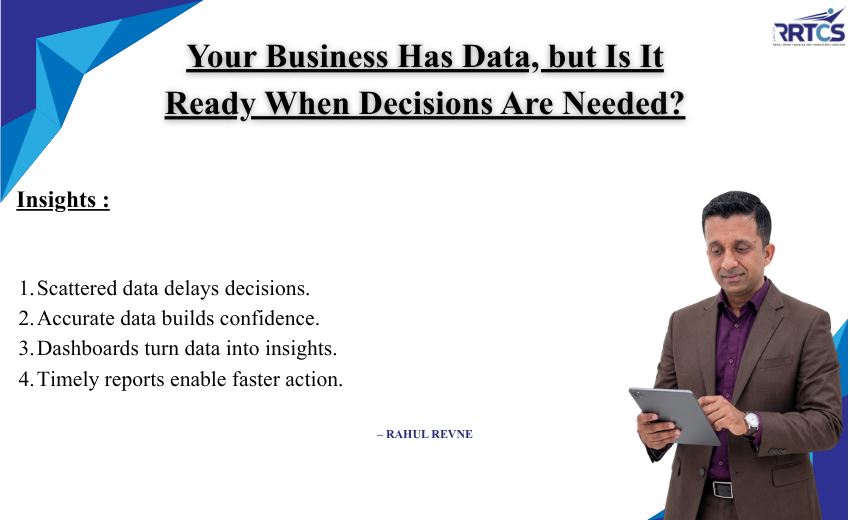
Your Business Is Generating Data Every Day. So Why Are You Still Guessing? Every day, your business is generating data. Every sale, customer inquiry, follow-up, complaint, delayed payment, repeat purchase, employee activity, and expense is leaving behind a footprint called data. The problem is not the lack of data. The problem is that many businesses collect it but don’t use it. Today, businesses have ERP systems, CRM software, Excel sheets, WhatsApp groups, dashboards, and reports. Yet, when an important decision has to be made, many founders still rely on statements like: “I think this will work.” “I have a gut feeling.” “Someone else did this, so let’s do the same.” And this is where problems begin. Data Is The Mirror Of Your Business Data is not just numbers. Data is reality. It shows you exactly what is happening inside your business. Sometimes, you may think sales are down because of the market, but data may reveal that customer follow-ups have decreased. Sometimes, you may blame marketing, but data may show that leads are coming in and conversions are the real issue. Without data, businesses run on opinions. With data, businesses run on facts. Stop Copying Other Businesses One of the biggest mistakes entrepreneurs make is blindly copying others. Someone launches a new product, opens a new branch, or changes pricing, and everyone follows. But every business is different. Your customers, team, costs, and market are different. Most importantly, your data is different. What works for another business may not work for yours. Past Success Doesn’t Guarantee Future Success Many businesses keep following old decisions because “we’ve always done it this way.” But markets change. Customers change. Competitors change. Technology changes. Experience is valuable, but experience without updated data can become dangerous. Even intuition needs verification. Data Helps You Take Better Decisions When businesses regularly track data, they can easily identify: Profitable products Customer behaviour and trends Underperforming sales channels Increasing expenses Team bottlenecks Market opportunities The goal is not to collect more data. The goal is to connect the data you already have and turn it into meaningful action. Final Thought Your intuition has value. Your experience has value. But they should never replace data. Because intuition tells you what you feel. Data tells you what is real. And businesses that depend only on assumptions eventually depend on luck. Luck is not a business strategy. _________________________________________________________________________________________ Author Bio Mr. Rahul Revne Founder of RRTCS (Rahul Revne Training & Consultancy Services), Mr. Rahul Revne brings over 15 years of experience in HR, Sales, Strategy, and end-to-end business consulting. Known for turning struggling ventures into thriving enterprises, he helps entrepreneurs master the art of meaningful customer connection, emotional intelligence in sales, and purpose-driven business growth. Author of Entrepreneurial Series and Spirit of Inspiration, Mr. Revne continues to empower leaders with clarity, courage, and customer focus.      

Founder standing at a crossroads between employee mindset and entrepreneur mindset, symbolizing business growth through systems, leadership, and strategic thinking.
Blog, Business Growth, system

Your Business Will Rarely Outgrow Your Mindset

Your Business Will Rarely Outgrow Your Mindset Most of us are trapped in patterns that we’ve been following for years. We think in a certain way, work in a certain way, make decisions in a certain way, and eventually that pattern becomes our mindset. The problem is that many entrepreneurs continue to run their businesses with the same mindset they had when they were employees. And that becomes one of the biggest hidden bottlenecks in business growth. Many founders believe their biggest challenges are competition, market conditions, lack of customers, or team issues. But often, the real limitation is much closer than that. It’s the founder’s mindset. An employee mindset focuses on doing everything personally, avoiding risks, controlling every small detail, and believing that nobody can do the work better than them. Many business owners also enjoy being busy all the time. They feel that being occupied from morning to evening is proof that they are running a successful business. But being busy and building a business are two very different things. In reality, many founders spend their entire day doing low-value or junk activities simply to satisfy their ego. They keep themselves involved in every small task because it makes them feel important. The irony is that even after becoming business owners, they continue to behave like employees. They are still operating the business instead of building the business. An entrepreneur mindset is completely different. Entrepreneurs build systems instead of dependency. They empower people instead of micromanaging them. They learn to trust, delegate, adapt, and continuously evolve. Unfortunately, many businesses reach a stage where the founder becomes the centre of everything. Every decision, every approval, every problem, and every customer eventually comes back to one person. At that point, an important realization is needed: Your business is controlling you; you are not controlling your business. If the business cannot move without your constant presence, you haven’t built a business yet. You have simply created a job for yourself. Growth requires a different way of thinking. You need: A mindset to grow, not just survive. A mindset to learn, not just rely on past experience. A mindset to adapt, not resist change. A mindset to build systems, not dependencies. A mindset to develop leaders, not followers. The truth is simple. As a founder grows, the business grows. As a founder evolves, the business evolves. And when a founder stops learning, the business often stops growing too. Markets will change. Customers will change. Technology will change. The question is: Will you change too? Because your business will rarely outgrow your mindset. _________________________________________________________________________________________ Author Bio Mr. Rahul Revne Founder of RRTCS (Rahul Revne Training & Consultancy Services), Mr. Rahul Revne brings over 15 years of experience in HR, Sales, Strategy, and end-to-end business consulting. Known for turning struggling ventures into thriving enterprises, he helps entrepreneurs master the art of meaningful customer connection, emotional intelligence in sales, and purpose-driven business growth. Author of Entrepreneurial Series and Spirit of Inspiration, Mr. Revne continues to empower leaders with clarity, courage, and customer focus.  

Business owner documenting employee knowledge into systems to reduce dependency and protect the business from knowledge loss when key employees leave.
Blog, Business Growth, system

Knowledge Is Trapped Inside People’s Heads

One Employee Resigns… And Years of Knowledge Leave With Them. Every business has that one employee. The person who has been with the organization for years. The one who knows every customer, every vendor, every process, every shortcut, and every solution. Whenever a problem arises, everybody says, “Ask him, he knows the answer.” At first, this feels like a strength. But hidden behind this strength is one of the biggest risks a business can create for itself. The Dependency We Often Ignore As founders, we appreciate experienced employees. We trust them, depend on them, and often make them the go-to person for every important task. But very few leaders stop and ask: What happens if this person is unavailable tomorrow? What if they take a long leave? What if they resign? What if an emergency forces them to step away from work? Will your business continue to function smoothly, or will everything suddenly slow down? Unfortunately, many businesses discover the answer only when it is too late. Experience Is Valuable Only When It Is Shared An employee may spend 10 or 15 years learning how to solve customer issues, manage vendors, handle exceptions, troubleshoot problems, and make critical decisions. Over time, they build tremendous knowledge and experience. But where does that knowledge exist? Is it documented anywhere? Is it part of a system? Or is it simply stored inside their memory? If the answer is “inside their head,” your business is operating with hidden risk every single day. The Cost of Undocumented Knowledge The moment a key employee leaves, problems begin to surface. Simple tasks become difficult. Decision-making slows down. Customers experience delays. New employees struggle to learn. And founders are forced to step back into daily operations instead of focusing on growth. The business that once looked stable suddenly becomes fragile. Turn Individual Knowledge Into Organizational Knowledge Your goal should never be to replace people. Your people are valuable. But your business should never become dependent on one person. Every experienced employee carries a valuable library inside their mind. Your responsibility as a leader is to convert that library into a company asset. Start asking questions such as: How do you solve this problem? What steps do you follow every time? What mistakes should others avoid? What decisions do you take in difficult situations? What lessons have you learned over the years? Then convert those answers into systems. Create: SOPs (Standard Operating Procedures) Checklists Training videos Process maps Department playbooks The goal is simple: Don’t let one person’s experience remain one person’s experience. Make it the company’s experience. Strong Businesses Are Built on Systems, Not Heroes A mature business is not the one that depends on its best employee. It is the one that can continue operating successfully even when that employee is unavailable. So, instead of asking: “What if my key employee leaves tomorrow?” Ask a better question: “If they leave tomorrow, will my business still know what to do?” If the answer is no, the time to start documenting is today. ________________________________________________________________________________________ Author Bio Mr. Rahul Revne Founder of RRTCS (Rahul Revne Training & Consultancy Services), Mr. Rahul Revne brings over 15 years of experience in HR, Sales, Strategy, and end-to-end business consulting. Known for turning struggling ventures into thriving enterprises, he helps entrepreneurs master the art of meaningful customer connection, emotional intelligence in sales, and purpose-driven business growth. Author of Entrepreneurial Series and Spirit of Inspiration, Mr. Revne continues to empower leaders with clarity, courage, and customer focus.    

Illustration representing different business models such as subscription, marketplace, commission, and one-time payment, highlighting how the right business model impacts business success and customer behavior.
Blog, Business Growth, system

A Wrong Business Model Can Kill Even a Great Product

Many founders copy competitors. If competitors use: Subscription Franchise Commission Freemium Marketplace Monthly pricing They also copy the same model. But what works for one business may fail in another. A great product with the wrong business model can still fail badly. Why? Because business models must match: Customer behavior Buying habits Cost structure Timing of value delivery Example: Some customers prefer: One-time payment Others prefer: Monthly subscription Some customers buy only after results. Others buy for convenience. That means your pricing and delivery model should fit how customers naturally buy. One famous example is Hilti. Instead of only selling tools, they created a monthly fleet management model. Customers did not care about owning tools. They cared about completing projects smoothly. So Hilti aligned the business model with customer reality. Another example is Xerox. Instead of only selling machines, they charged customers per copy usage. That reduced entry barriers and created recurring revenue. The lesson is important: Don’t blindly copy business models. Ask these questions: How does my customer get value? When does the customer experience the value? What payment structure feels natural to the market? Can this model scale profitably? A business model should support growth. Not create friction. Because sometimes the product is not the problem. The model is. _________________________________________________________________________________________ Author Bio Mr. Rahul Revne Founder of RRTCS (Rahul Revne Training & Consultancy Services), Mr. Rahul Revne brings over 15 years of experience in HR, Sales, Strategy, and end-to-end business consulting. Known for turning struggling ventures into thriving enterprises, he helps entrepreneurs master the art of meaningful customer connection, emotional intelligence in sales, and purpose-driven business growth. Author of Entrepreneurial Series and Spirit of Inspiration, Mr. Revne continues to empower leaders with clarity, courage, and customer focus.

Business growth illustration showing increasing revenue but declining profitability due to hidden business model problems and operational complexity.
Blog, Business Growth, system

You’re Growing, But Are You Actually Making Money?

Many businesses increase sales every year.   But profit still remains low. Why? Because more revenue does not always mean a healthier business. Sometimes businesses are growing in the wrong way. For example: Wrong customer segment High acquisition cost Low-margin products Too much customization Heavy operational complexity From outside, the business looks successful. Inside, profitability keeps getting weaker. That is why founders should regularly do a Business Model Audit. A business model audit is not only about checking sales numbers. It means understanding: Which products actually make profit Which customers are worth serving Which channels create real returns Where money is leaking Which activities are scalable One of the most important metrics is: Customer Lifetime Value (LTV) vs Customer Acquisition Cost (CAC). Simple meaning: “How much do you earn from a customer compared to how much you spend to acquire them?” If acquisition cost is too high, growth becomes dangerous. Another big issue is complexity. Many businesses keep adding: More products More exceptions More offers More customization Result: More confusion, more manpower, more cost. Not more profit. A strong business model should be: Repeatable Predictable Scalable Profitable The real question is not: “How much revenue are we generating?” The real question is: “How much healthy profit are we creating?” Because sometimes the problem is not sales. The problem is the business model itself. ________________________________________________________________________________________ Author Bio Mr. Rahul Revne Founder of RRTCS (Rahul Revne Training & Consultancy Services), Mr. Rahul Revne brings over 15 years of experience in HR, Sales, Strategy, and end-to-end business consulting. Known for turning struggling ventures into thriving enterprises, he helps entrepreneurs master the art of meaningful customer connection, emotional intelligence in sales, and purpose-driven business growth. Author of Entrepreneurial Series and Spirit of Inspiration, Mr. Revne continues to empower leaders with clarity, courage, and customer focus.      

Scroll to Top