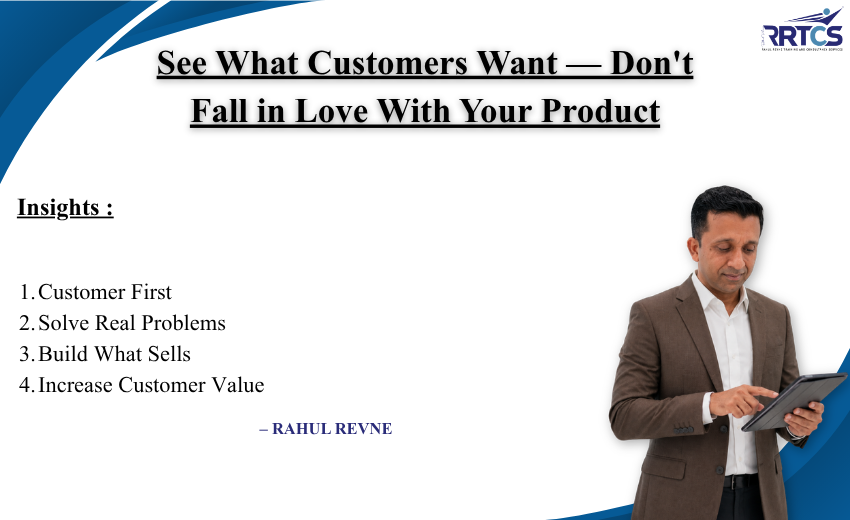

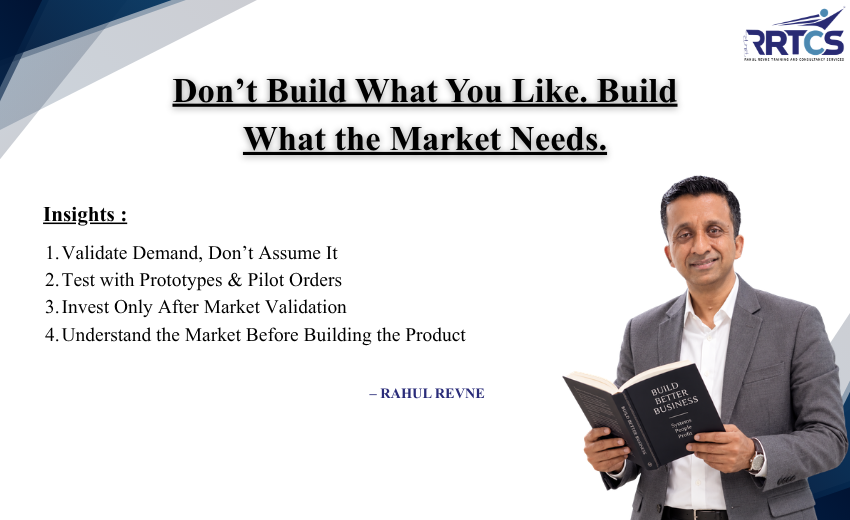
Don’t Build What You Like. Build What the Market Needs.
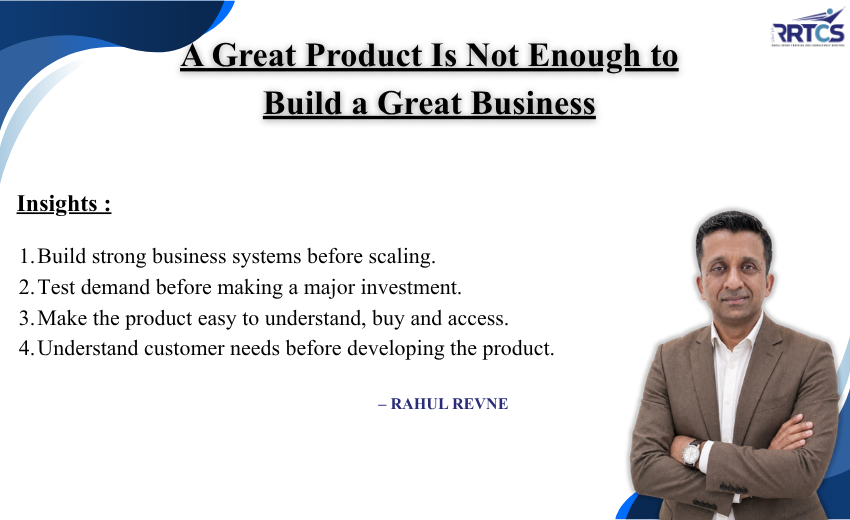
Many business owners make a costly mistake during product development: They start with the product instead of starting with the market. A founder sees an opportunity, likes an idea, discusses it internally and thinks, “Customers will definitely buy this.” Then comes the investment—new machinery, raw material, packaging, inventory and production capacity. But after the product reaches the market, the expected orders don’t come. The problem may not be the quality of the product. The problem may be that demand was assumed, not validated. A Practical Example Imagine an Indian manufacturing company producing industrial components. The founder identifies an opportunity to launch a new premium component. The technical team confirms that it can be manufactured, and the business considers investing ₹25–30 lakh in machinery and inventory. Instead of immediately making that investment, the company first validates the opportunity. It speaks with 15 existing customers to understand their actual requirements. It asks distributors what customers are currently requesting and why competing products are being selected. It develops a few prototypes and gets them tested by potential customers. Then, instead of producing 5,000 units, it takes a few pilot orders. Now the company has something more valuable than an internal opinion: Evidence of market demand. If customers respond positively, repeat orders come in and distributors show interest, the company has stronger reasons to invest further. If the response is weak, the company can change the product, pricing, specifications or positioning—before ₹30 lakh gets locked into machinery and inventory. Before Product Development, Validate Five Things A simple framework for founders can be: Problem → Customer → Feedback → Pilot → Investment Problem What real customer problem are we solving? Customer Who specifically needs this product, and who will actually pay for it? Feedback What are customers, distributors and salespeople telling us about specifications, pricing and expectations? Pilot Can we test the idea through prototypes, samples or small pilot orders? Investment What measurable evidence tells us that larger investment in machinery, people or inventory is justified? The sequence matters. Investment should follow validation—not replace it. Questions Every Founder Should Ask Before approving a new product, ask: How many potential customers have we actually spoken with? What problem did they say they need solved? Have distributors or salespeople confirmed similar demand? Have customers tested a prototype or sample? Have we received pilot orders—or only positive comments? What numbers will determine whether we scale, modify or stop the product? Who is accountable for collecting and reviewing this market feedback? These questions turn product development from an assumption-driven decision into a measurable process. Product Development Also Needs a System Customer interviews are useful only when their insights are documented. Distributor feedback matters only when someone reviews it. Pilot orders matter only when conversion, repeat demand, margins and complaints are measured. That is where systems, accountability and execution become important. A business can create a simple Product Validation Dashboard tracking: Customers Interviewed | Distributor Feedback | Prototypes Tested | Pilot Orders | Conversion | Repeat Orders | Margin | Decision Now product development is not dependent only on the founder saying, “I think this will work.” The organization has a process to determine whether it is working. Build for the Market, Not for Yourself A founder’s instinct and experience are valuable. But they become far more powerful when supported by customer evidence and measurable execution. Before investing heavily in your next product, spend more time understanding the customer. Talk to the market. Build prototypes. Take pilot orders. Measure the response. Then scale what the market proves it wants. At RRTCS, our Business Analysis helps founders identify gaps in leadership, systems, accountability and execution that may be keeping the organization dependent on them. If you want to identify the leadership and system gaps keeping your business founder-dependent, message me “Business Analysis.” ________________________________________________________________________________________ Author Bio Mr. Rahul Revne Founder of RRTCS (Rahul Revne Training & Consultancy Services), Mr. Rahul Revne brings over 15 years of experience in HR, Sales, Strategy, and end-to-end business consulting. Known for turning struggling ventures into thriving enterprises, he helps entrepreneurs master the art of meaningful customer connection, emotional intelligence in sales, and purpose-driven business growth. Author of Entrepreneurial Series and Spirit of Inspiration, Mr. Revne continues to empower leaders with clarity, courage, and customer focus. To know more visit our website : www.rrtcs.com