Author name: lakod

The Opportunity Cost not Neglecting
Blog, Business Growth

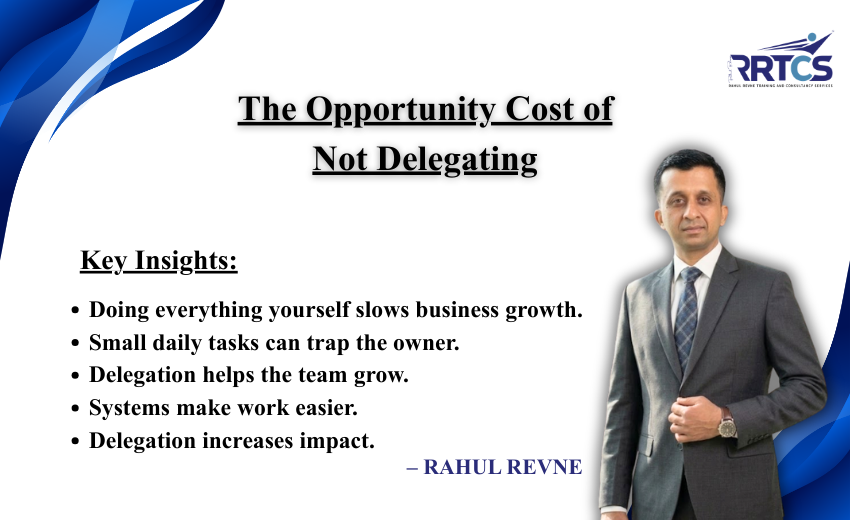
The Opportunity Cost of Not Delegating

Many business owners believe that doing everything themselves ensures quality and control. In the early stages of a business, this approach often works because the founder is deeply involved in every function. However, as the business grows, not delegating becomes expensive — not in salary, but in opportunity cost. Opportunity cost is the value of what you give up when you choose one activity over another. For business owners, this means that every hour spent on tasks others could handle is an hour not spent on activities that truly drive growth. When the Owner Becomes the Bottleneck Without delegation, owners often get trapped in day-to-day operations: Administrative work Small operational issues Internal coordination Routine problem-solving These tasks consume time and energy that could instead be used for: Meeting new clients Building partnerships Strategic thinking Expanding the business Over time, something ironic happens — the owner becomes the employee of their own business. The business cannot move without them, and growth becomes limited by their personal bandwidth. Why Many Owners Don’t Delegate Most founders hesitate to delegate because of three common fears: Fear of losing control Doubt about the quality of work Habit of doing everything themselves But this mindset often creates the very problem they want to avoid: a business that depends entirely on them. The Real Cost of Poor Delegation Not delegating affects the business in several ways. Lost strategic focusLeaders spend time on low-impact tasks instead of focusing on growth and strategy. Underdeveloped teamsWhen responsibilities are not delegated, employees don’t get the chance to take ownership and grow. A business that cannot run without the ownerEvery decision and task flows through one person, creating bottlenecks and limiting scalability. Systems Reduce Owner Dependency To delegate effectively, businesses must rely on systems rather than the owner’s constant involvement. Documenting simple processes for sales, operations, customer service, and finance creates clarity and consistency. When systems exist, team members can execute tasks confidently without escalating everything to the owner. This shifts the owner’s role from operational firefighting to strategic leadership. Three Simple Steps to Start Delegating Identify tasks that don’t require youOperational and administrative tasks can often be handled by others. Set clear expectationsDefine goals, deadlines, and quality standards so tasks can be completed independently. Build trust with your teamEmpower people, support them, and allow them to take ownership of responsibilities. Delegation is not about losing control. It’s about multiplying your impact through people and systems. If a business cannot run without the owner, it cannot truly grow. And the longer delegation is delayed, the higher the opportunity cost becomes. A strong business is not built by doing everything yourself. It is built by creating systems and people who can run it with you — and eventually without you.   If you want to understand the bottlenecks in your business and identify what is slowing down your decisions, book your Founder Audit today. Why RRTCS? At RRTCS – Rahul Revane Training & Consultancy Services, we help entrepreneurs implement the Profit First framework in their businesses: ✅ Designing KPI-driven financial dashboards✅ Identifying profit leakage points✅ Creating SOPs for expense control✅ Training teams to think “Profit First” in every decision Because real growth does not come from bigger sales alone —it comes from better profits. 👉 With RRTCS, you do not just earn more — you save more as well.

Unstructured Meetings = Payroll Loss
Blog, Business Growth

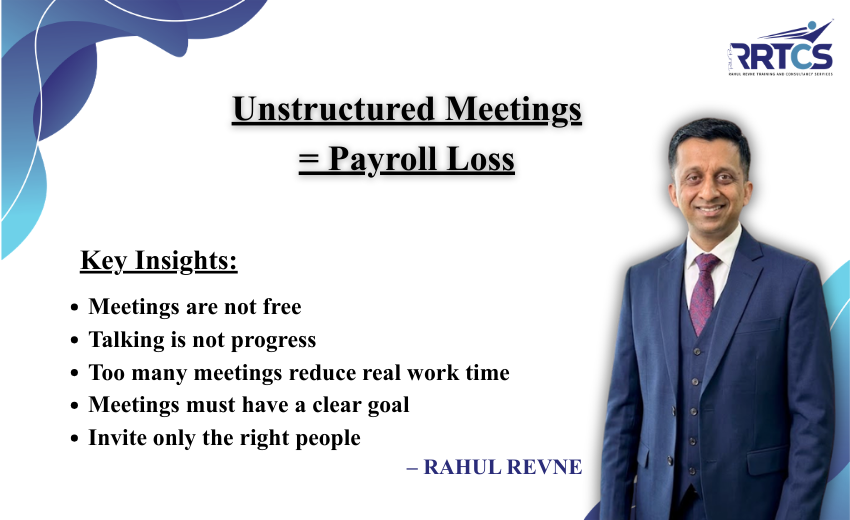
Unstructured Meetings = Payroll Loss

Meetings are meant to move work forward. But in many organizations, meetings have quietly become a hidden drain on productivity and payroll. Instead of being tools for discussion and decision-making, meetings often turn into long conversations where ideas circulate but little actual work gets done afterward. The result? Employees spend hours talking about work instead of doing the work. And every one of those hours is paid for. Meetings Should Lead to Decisions A meeting should exist for two clear reasons: To clarify a problem To make a decision Once a decision is made, the real work should happen outside the meeting — execution, implementation, and progress. However, what happens in reality is often the opposite. Teams spend most of their time discussing, debating, and revisiting the same topics, leaving little time for actual implementation. Discussion can feel productive, but execution is what produces results. The Hidden Cost of Meetings Most businesses track expenses like rent, marketing budgets, and software subscriptions. But very few calculate the cost of meetings. Let’s take a simple example. If an employee earns ₹40,000 per month, the annual salary cost is about ₹4,80,000. That translates to roughly ₹230–₹250 per working hour. Now imagine a meeting with 10 employees. A single one-hour meeting costs the organization around ₹2,500 in salary expenses alone. And this still doesn’t include: Management salaries Opportunity cost of delayed work Productivity loss from interruptions If such meetings happen several times every week, the cost quietly turns into lakhs of rupees every year. In simple terms: Meetings are not free. They are paid conversations. The Productivity Problem Too many meetings also reduce the time available for focused work. Employees need uninterrupted time to: solve problems design solutions write code plan strategies complete tasks When calendars are filled with meetings, people are forced to rush real work between meetings or complete it after hours. Frequent meetings also break concentration. Each meeting requires employees to mentally switch contexts, which reduces focus and efficiency. Over time, excessive meetings act like a productivity tax on the entire organization. Why Many Meetings Fail Most meetings fail not because the topic is wrong, but because the structure is missing. Common problems include: No clear agenda Without a defined agenda, discussions drift without reaching a decision. Too many participants When too many people are invited, most become silent observers instead of contributors. Dominating speakers Sometimes only the loudest voices dominate the conversation while valuable ideas remain unheard. No actionable outcome Many meetings end without clear decisions, responsibilities, or deadlines. It could have been an email Status updates and announcements rarely require meetings. When people realize the discussion could have been handled in a message or email, the meeting feels like time taken away from real work. The Real Rule of Meetings A simple rule can dramatically improve meeting culture: If a meeting does not create clarity, decisions, or action — it should not happen. But there is another rule that many organizations ignore. Every meeting must have a fixed time limit. For example: Discussion meetings: 20–30 minutes Planning meetings: 30–45 minutes Decision meetings: 15–20 minutes When meetings have no time boundary, discussions naturally expand. To maintain discipline, teams can introduce simple accountability rules. For example: Meetings automatically end at the scheduled time. If a meeting runs longer, the organizer must explain why or schedule a follow-up with a smaller group. These small structures help teams respect time and stay focused. Before You Call a Meeting, Ask These 3 Questions Before scheduling a meeting, ask yourself: Is a meeting really necessary? Could this be handled through an email, message, or shared document? What decision needs to be made? If there is no clear decision or outcome expected, the meeting may not be needed. Who actually needs to be there? Invite only people who are directly involved in the discussion or decision. If these three questions cannot be answered clearly, the meeting will likely waste time rather than create progress.   Meetings should accelerate progress, not create the illusion of progress. When meetings are structured properly, they help teams align, solve problems, and make decisions faster. But when they are unstructured, they quietly drain time, productivity, morale, and payroll. And that is why unstructured meetings are not just inefficient — they are a payroll loss.   If you want to understand the bottlenecks in your business and identify what is slowing down your decisions, book your Founder Audit today. Why RRTCS? At RRTCS – Rahul Revane Training & Consultancy Services, we help entrepreneurs implement the Profit First framework in their businesses: ✅ Designing KPI-driven financial dashboards✅ Identifying profit leakage points✅ Creating SOPs for expense control✅ Training teams to think “Profit First” in every decision Because real growth does not come from bigger sales alone —it comes from better profits. 👉 With RRTCS, you do not just earn more — you save more as well.

The Real Cost of Micromanagement and the System-Driven Management Model
Blog, Business Growth

Micromanagement की असली Cost और System-Driven Management Model

व्यवसाय में एक बहुत सामान्य लेकिन खतरनाक गलती होती है — Micromanagement.कई managers इसे control बनाए रखने और high standards maintain करने का तरीका समझते हैं, लेकिन वास्तविकता में यह management style अक्सर organization की growth को धीमा कर देती है। एक leader का काम हर छोटे task को monitor करना नहीं होता। उसका असली काम strategy, vision और growth opportunities पर काम करना होता है। लेकिन जब leader operations के हर छोटे decision में involved हो जाता है, तब organization का focus long-term strategy से हटकर day-to-day control में फंस जाता है। इसीलिए आज की modern management philosophy में एक महत्वपूर्ण बदलाव आया है —Micromanagement से System-Driven Management की ओर। Micromanagement क्या है? Micromanagement एक ऐसी management style है जिसमें manager कर्मचारियों के काम को अत्यधिक नज़दीकी से monitor और control करता है। इसके कुछ सामान्य संकेत हैं: लगातार updates मांगना tasks delegate करने में hesitation हर decision को approve करना कर्मचारियों के काम में बार-बार corrections करना process की जगह व्यक्ति पर निर्भर रहना Manager का उद्देश्य अक्सर quality maintain करना होता है, लेकिन इसका परिणाम अक्सर उल्टा होता है। Micromanagement की असली Cost Micromanagement की cost सिर्फ emotional या cultural नहीं होती, बल्कि इसका direct business impact भी होता है। 1. Leadership Time का गलत उपयोग जब leader हर operational detail में involve होता है, तब वह अपना समय उन कामों में लगा रहा होता है जो team members भी कर सकते हैं। इसका परिणाम: Strategy पर कम ध्यान Innovation में कमी Growth opportunities miss होना एक सफल leader का समय direction देने में लगना चाहिए, execution करने में नहीं। 2. Team Motivation में गिरावट जब employees को हर कदम पर monitor किया जाता है, तो उन्हें लगता है कि: उन पर भरोसा नहीं किया जा रहा उनकी capability पर doubt है उन्हें independently काम करने की freedom नहीं है एक survey के अनुसार: 85% professionals ने कहा कि micromanagement से उनका morale negatively impact हुआ 71% professionals ने कहा कि इससे उनकी job performance प्रभावित होती है 69% employees ने micromanagement की वजह से job change करने के बारे में सोचा 36% employees ने वास्तव में job change कर लिया जब employee को ownership नहीं मिलती, तो वह केवल instructions follow करने लगता है, innovation नहीं करता। 3. Productivity Slow हो जाती है Micromanagement workflow को भी धीमा कर देता है। क्योंकि: हर decision approval के लिए जाता है employees initiative लेने से बचते हैं feedback loop बहुत लंबा हो जाता है इसका परिणाम यह होता है कि एक project जिसे 10 घंटे में पूरा होना चाहिए था, वह 20 घंटे ले लेता है। 4. Creativity और Learning रुक जाती है Micromanagement employees को experiment करने की freedom नहीं देता। लेकिन business growth के लिए जरूरी है: experimentation problem-solving innovation जब हर step predefined instructions से control होता है, तब learning culture develop नहीं होता। Micromanagement की सबसे बड़ी वजह Micromanagement अक्सर दो कारणों से पैदा होता है: Trust की कमी System की कमी बहुत बार manager यह सोचता है कि अगर वह खुद check नहीं करेगा तो mistakes हो जाएंगी। लेकिन असली समस्या employees नहीं होती, बल्कि clear systems और processes का अभाव होता है। Solution: System-Driven Management Model Micromanagement का सबसे प्रभावी समाधान हैSystem-Driven Business Model। इस model में business व्यक्ति पर नहीं, बल्कि defined systems और processes पर चलता है। इसका मतलब: काम करने की clear methodology standard operating procedures (SOPs) defined workflows automation tools accountability checkpoints जब system clear होता है, तो manager को हर step monitor करने की जरूरत नहीं पड़ती। System-Driven Model कैसे Micromanagement खत्म करता है 1. Roles और Processes पहले से Defined होते हैं System-driven model में हर काम के लिए: clear steps responsible person expected output पहले से defined होते हैं। इससे confusion कम हो जाता है और employees को बार-बार guidance की जरूरत नहीं पड़ती। 2. Monitoring होती है, Micromanaging नहीं System-driven model में monitoring होती है, लेकिन हर step पर intervention नहीं होता। Example: checkpoints defined होते हैं reports automated होती हैं dashboards performance दिखाते हैं इससे leader केवल important points पर review करता है, हर detail में involve नहीं होता। 3. Senior Leaders का Time बचता है जब system मजबूत होता है, तो leaders: operations से बाहर निकल सकते हैं strategy पर focus कर सकते हैं new opportunities explore कर सकते हैं यही कारण है कि बड़ी companies systems पर चलती हैं, individuals पर नहीं। System-Driven Business Model के फायदे 1. Scalability जब processes repeatable होते हैं, तो business आसानी से expand कर सकता है। 2. Operational Consistency Defined workflows से customer experience consistent रहता है। 3. Reduced Owner Dependency Business owner हर decision में शामिल हुए बिना भी operations smoothly चल सकते हैं। 4. Faster Onboarding New employees को train करना आसान हो जाता है क्योंकि system पहले से defined होता है। 5. Passive Growth Potential Automation और structured processes business को owner-independent बना सकते हैं। Effective Leadership का नया Formula आज के modern business environment में leadership का focus होना चाहिए: Control से ज्यादा System परऔर Supervision से ज्यादा Empowerment पर। Micromanagement short-term mistakes कम कर सकता है, लेकिन long-term growth को रोक देता है। वहीं system-driven management: leaders को strategic बनाता है teams को empowered बनाता है business को scalable बनाता है Micromanagement अक्सर good intentions से शुरू होता है, लेकिन समय के साथ यह organization की productivity, culture और innovation को नुकसान पहुंचाता है। एक sustainable business बनाने के लिए जरूरी है कि leaders हर काम खुद करने की बजाय systems create करें। क्योंकि आखिरकार एक मजबूत business व्यक्ति पर नहीं, बल्कि system पर खड़ा होता है। अगर आप जानना चाहते हैं कि आपके बिजनेस में कहाँ bottlenecks बन रहे हैं और कौन-से decisions आपकी growth को slow कर रहे हैं — तो अभी अपना Founder Audit book करें। क्यों RRTCS? RRTCS – Rahul Revane Training & Consultancy Services में हम आंत्रप्रेन्योर्स को प्रॉफिट फ़र्स्ट फ्रेमवर्क लागू करने में मदद करते हैं: ✅ केपीआई-ड्रिवन फ़ाइनेंशियल डैशबोर्ड डिज़ाइन करना✅ प्रॉफिट लीकेज पॉइंट्स पहचानना 

The Real Cost of Micromanagement and the System-Driven Management Model
Blog, Business Growth

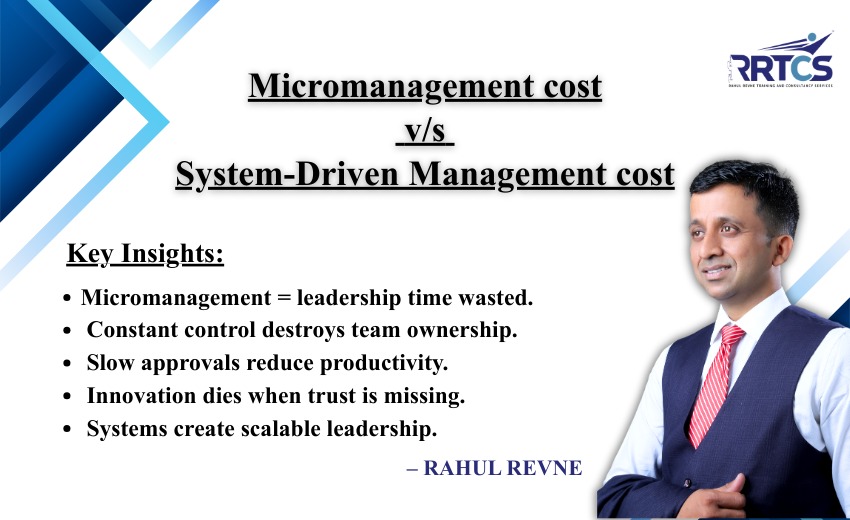
The Real Cost of Micromanagement and the System-Driven Management Model

In many organizations, one common but damaging management mistake continues to exist — micromanagement. Many managers believe that closely monitoring every task helps maintain control and ensures high standards. However, in reality, this management style often slows down organizational growth. A leader’s role is not to supervise every small task. The real responsibility of leadership is to focus on strategy, vision, and long-term growth. But when leaders become deeply involved in operational details, their focus shifts from strategic thinking to daily control. This is why modern management thinking is increasingly moving from micromanagement to system-driven management. What Is Micromanagement? Micromanagement is a management style in which a manager closely observes and controls the work of employees. Common signs of micromanagement include: Constantly asking for updates Difficulty delegating tasks Requiring approval for every decision Rewriting or excessively correcting employees’ work Dependence on individuals instead of processes Managers often adopt this approach to maintain quality and avoid mistakes, but the results are often the opposite of what they expect. The Real Cost of Micromanagement The cost of micromanagement is not only emotional or cultural — it also has a direct business impact. 1. Misuse of Leadership Time When leaders involve themselves in every operational detail, they spend time on work that team members are capable of doing themselves. This leads to: Less focus on strategy Reduced innovation Missed growth opportunities A successful leader should spend time creating direction, not executing every task. 2. Decline in Team Motivation When employees are constantly monitored, they begin to feel that: Their manager does not trust them Their capabilities are being questioned They do not have the freedom to work independently Research highlights the seriousness of the issue: 85% of professionals reported that micromanagement negatively impacted their morale 71% said it interfered with their job performance 69% considered leaving their jobs because of micromanagement 36% actually changed jobs When employees are not given ownership of their work, they stop taking initiative and simply follow instructions. 3. Slower Productivity Micromanagement also slows down workflow. This happens because: Every decision requires approval Employees hesitate to take initiative Feedback loops become longer As a result, a project that should take 10 hours may end up taking 20 hours. 4. Creativity and Learning Are Suppressed Micromanagement leaves little room for experimentation. However, business growth depends heavily on: Experimentation Problem-solving Innovation When employees are constantly controlled, they become cautious and avoid trying new approaches. Over time, the organization loses its innovative edge. The Root Cause of Micromanagement Micromanagement usually arises due to two key reasons: Lack of trust Lack of systems Managers often believe that if they do not personally check everything, mistakes will happen. But the real issue is often not the employees — it is the absence of clear systems and processes. The Solution: A System-Driven Management Model The most effective solution to micromanagement is adopting a system-driven business model. In this model, a business operates not on the constant involvement of individuals but on well-defined systems and processes. This includes: Standard Operating Procedures (SOPs) Defined workflows Automation tools Accountability checkpoints Clear roles and responsibilities When systems are well designed, managers do not need to monitor every step. How a System-Driven Model Eliminates Micromanagement 1. Roles and Processes Are Clearly Defined In a system-driven organization, every task has: Clear steps A responsible person A defined outcome This reduces confusion and minimizes the need for constant supervision. 2. Monitoring Without Micromanaging System-driven management does not eliminate supervision, but it shifts the focus. Instead of controlling every small activity, managers review performance at predefined checkpoints. Examples include: Performance dashboards Automated reports Periodic reviews This allows leaders to stay informed without interfering with daily execution. 3. Leaders Save Time Strong systems free leaders from operational overload. As a result, leaders can focus on: Strategy Expansion opportunities Innovation Long-term planning This is why large and successful organizations rely heavily on systems rather than individuals. Advantages of a System-Driven Business Model Scalability When processes are repeatable, businesses can grow faster without depending on a single individual’s time and energy. Operational Consistency Standardized workflows create consistent results and a reliable customer experience. Reduced Owner Dependency A well-designed system allows the business to run smoothly even when the owner is not involved in every decision. Faster Employee Onboarding New employees can quickly adapt because processes are already documented and structured. Greater Efficiency and Growth Potential Automation and structured systems enable businesses to operate more efficiently and open opportunities for expansion. The New Formula for Effective Leadership In modern organizations, leadership must shift its focus from control to systems and from supervision to empowerment. Micromanagement may reduce short-term mistakes, but it damages long-term growth. System-driven management, on the other hand: Allows leaders to think strategically Empowers teams to take ownership Creates scalable and sustainable businesses Micromanagement often begins with good intentions, but over time it harms productivity, organizational culture, and innovation. To build a sustainable business, leaders must move away from trying to control every task and instead focus on creating strong systems. Because in the long run, successful businesses are not built on individuals — they are built on systems that allow people to perform at their best. If you want to understand the bottlenecks in your business and identify what is slowing down your decisions, book your Founder Audit today. Why RRTCS? At RRTCS – Rahul Revane Training & Consultancy Services, we help entrepreneurs implement the Profit First framework in their businesses: ✅ Designing KPI-driven financial dashboards✅ Identifying profit leakage points✅ Creating SOPs for expense control✅ Training teams to think “Profit First” in every decision Because real growth does not come from bigger sales alone —it comes from better profits. 👉 With RRTCS, you do not just earn more — you save more as well.

Approval Bottleneck = Lost Deals: Decision Authority Matrix का Framework
Blog, Business Growth

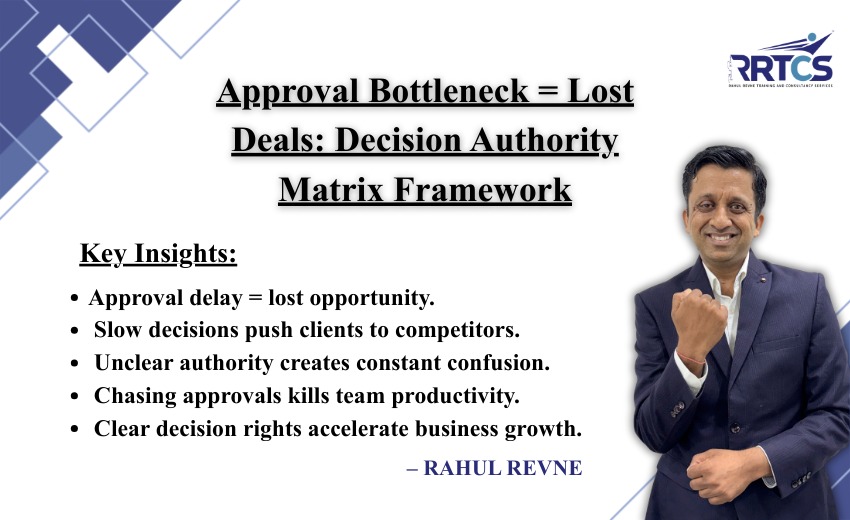
Approval Bottleneck = Lost Deals: Decision Authority Matrix का Framework

Approval Bottleneck = Lost Deals In any organization, speed of decision-making is extremely important. Many times businesses do not lose deals because their product is poor or their price is high. They lose deals because the decision was not made on time. When the approval process becomes slow and work gets stuck with one person, it creates what is called an approval bottleneck. If the authority to make decisions lies with only one person, and that person is busy, unavailable, or occupied with other tasks, the entire process stops. The direct impact of this is on business — deals get delayed or move to competitors. This is why organizations must create a clear Decision Authority Matrix. What is an Approval Bottleneck? An approval bottleneck occurs when approvals themselves become the biggest obstacle in completing work. This situation usually happens when: Every small or large task requires approval Multiple people must approve one after another It is not clear who has the final decision authority In such situations, employees spend less time doing actual work and more time chasing approvals. Why Do Approval Bottlenecks Happen? The “Too Many Cooks” Problem (Excessive Hierarchy) In many organizations, the approval process becomes so long that work cannot move forward quickly. Sequential Sign-offs Sometimes a proposal needs approval from a manager, then finance, then legal, and finally senior management. If even one person delays the process, the entire workflow stops. Over-Centralized Authority When all decisions must go through senior leadership, their capacity becomes the speed limit of the organization. Lack of Clear Ownership If it is not clear who has the final authority to make a decision, requests keep moving between departments and decisions keep getting delayed. Manual and Disconnected Processes Many organizations still rely on emails or chat messages for approvals. Email Approvals Approval requests often get lost in crowded inboxes or go unnoticed. Lack of Visibility Without a proper tracking system, employees must constantly follow up for approvals. Incomplete Information If a request is missing important information, it has to be sent again. This adds unnecessary steps and delays. Behavioral and Cultural Factors Sometimes the bottleneck is not caused by systems but by organizational culture. Unavailability of Approvers If a key decision-maker is on leave or too busy, the entire workflow stops. Risk Aversion Some organizations create multiple layers of checking even for small decisions. Approval Inflation Routine tasks also require unnecessary approvals, which increases delays. The Impact of Approval Bottlenecks Approval delays affect several areas of an organization. Lost Opportunities If decisions are not made quickly, deals may move to competitors. Reduced Productivity Employees spend more time chasing approvals instead of doing meaningful work. Employee Frustration Frequent delays demotivate employees and create frustration. Financial Loss Delays in vendor payments may lead to penalties and damage business relationships. The Solution: Decision Authority Matrix To avoid approval bottlenecks, organizations should create a Decision Authority Matrix. This means clearly defining: Who can make decisions at which level In which situations approvals are required Who needs to be informed Example Suppose there is a sales team. Amount Decision Authority Up to ₹5,000 Salesperson ₹5,000 – ₹25,000 Sales Manager Above ₹25,000 Senior Management This allows the sales team to make quick decisions for smaller deals without waiting for senior approval every time. Frameworks for Clear Decision-Making Organizations often use structured frameworks to clarify roles and responsibilities in decision-making. The RACI Framework RACI is a responsibility matrix that clarifies roles in a project or task. RACI Components ResponsibleThe person who performs the task. AccountableThe person who makes the final decision and is responsible for the result. ConsultedPeople whose advice or expertise is needed. InformedPeople who should be kept updated about the decision. RACI helps reduce confusion and ensures smoother execution. The DACI Framework The DACI framework simplifies the decision-making process. DACI Roles DriverThe person who manages the decision process. ApproverThe person who makes the final decision. ContributorsExperts who provide suggestions and insights. InformedPeople who need to be notified about the decision. This framework is especially useful for complex projects and cross-functional teams. How to Reduce Approval Bottlenecks Automate Workflows Use digital tools to automate approval processes. Delegate Authority Allow team members to make smaller decisions within defined limits. Define Approval Timelines Set clear timelines for approvals. Enable Parallel Approvals If possible, allow departments to review requests in parallel instead of sequentially. In today’s competitive business environment, slow decisions can be very costly. Approval bottlenecks slow down organizational growth and can even result in lost deals. Every organization should therefore: Create a Decision Authority Matrix Clearly define roles and responsibilities Simplify and speed up the approval process When decision authority is clear, organizations move faster, capture opportunities, and stay ahead of the competition. Because in business, there is a simple rule: “Companies that make faster decisions win the market.” If you want to understand the bottlenecks in your business and identify what is slowing down your decisions, book your Founder Audit today. Why RRTCS? At RRTCS – Rahul Revane Training & Consultancy Services, we help entrepreneurs implement the Profit First framework in their businesses: ✅ Designing KPI-driven financial dashboards✅ Identifying profit leakage points✅ Creating SOPs for expense control✅ Training teams to think “Profit First” in every decision Because real growth does not come from bigger sales alone —it comes from better profits. 👉 With RRTCS, you do not just earn more — you save more as well.

If the Knowledge Lives in Your Team’s Mind, the Business Is Not Yours
Blog, Business Growth

अगर नॉलेज टीम के दिमाग में है तो बिज़नेस आपका नहीं है

RRTCS  ने अलग-अलग इंडस्ट्री के कई बिज़नेस के साथ काम करते हुए एक पैटर्न बार-बार देखा है।एक सच्चाई हमेशा सामने आती है:अगर आपके बिज़नेस का नॉलेज सिर्फ टीम की मेमोरी में है और डॉक्यूमेंटेड सिस्टम्स में नहीं है, तो बिज़नेस आपका नहीं है — वह एम्प्लॉइज़ का है। हिडन रिस्क: अनडॉक्यूमेंटेड नॉलेज बहुत सारी कंपनियों में यह सिचुएशन होती है: कोई प्रोसेस लिखा हुआ नहीं कोई एसओपी नहीं की क्लाइंट्स कौन हैं और उनका वेटेज क्या है — कोई रिकॉर्ड नहीं क्लाइंट बिहेवियर, प्रेफरेंस या डिसीजन पैटर्न की कोई नोट्स नहीं सप्लायर कम्युनिकेशन हिस्ट्री नहीं सब कुछ मेमोरी और पर्सनल एक्सपीरियंस पर चल रहा होता है।जब तक की पर्सन है, सब स्मूथ लगता है।लेकिन जिस दिन वह नहीं रहता, सिस्टम कोलैप्स हो जाता है। यह बिज़नेस के अंदर एक सिंगल पॉइंट ऑफ फेल्योर क्रिएट करता है। जब की एम्प्लॉई चला जाता है असल रिस्क तब दिखता है जब कोई इम्पॉर्टेंट व्यक्ति: रिज़ाइन कर देता है लॉन्ग लीव पर चला जाता है अचानक अनअवेलेबल हो जाता है अचानक: काम रुक जाता है क्लाइंट्स को रिस्पॉन्स नहीं मिलता फॉलो-अप्स टूट जाते हैं सप्लायर रिलेशन कमजोर हो जाते हैं नई ऑपर्च्युनिटीज मिस हो जाती हैं टीम कन्फ्यूज़ हो जाती है और सबसे बड़ा नुकसान: क्लाइंट ट्रस्ट। उस समय ओनर को समझ आता है: “बिज़नेस सिस्टम पर नहीं, एक पर्सन पर चल रहा था।” खुद से ये 5 स्ट्रैटेजिक सवाल पूछिए अपने सबसे क्रिटिकल एम्प्लॉई के बारे में सोचिए: अगर वह कल से काम बंद कर दे तो क्या होगा? क्या आपको पता है वह अभी किन कामों पर काम कर रहा है? कौन से क्लाइंट्स सीधे उस पर डिपेंडेंट हैं? उसका एक्ज़ैक्ट वर्किंग प्रोसेस क्या है? क्या कोई दूसरा तुरंत उसकी जगह काम संभाल सकता है? अगर इनका आंसर “नो” है,तो आपका बिज़नेस हाई ऑपरेशनल रिस्क में है। पर्सन-डिपेंडेंट बनाम सिस्टम-ड्रिवन बिज़नेस पर्सन-डिपेंडेंट: नॉलेज लोगों के दिमाग में व्यक्ति गया तो काम बंद ओनर स्ट्रेस्ड ग्रोथ लिमिटेड सिस्टम-ड्रिवन: नॉलेज डॉक्यूमेंट्स में काम स्मूथली चलता है ओनर के पास विज़िबिलिटी बिज़नेस स्केलेबल पर्सन-डिपेंडेंट मॉडल बिज़नेस नहीं, एक फ्रैजाइल स्ट्रक्चर है। क्या करना चाहिए? 1. नॉलेज कैप्चर सिस्टम बनाइए अपने की टीम मेंबर्स के साथ बैठकर डॉक्यूमेंट करें: स्टेप-बाय-स्टेप प्रोसेसेस की क्लाइंट लिस्ट + वेटेज क्लाइंट बिहेवियर और कम्युनिकेशन स्टाइल प्राइसिंग लॉजिक नेगोशिएशन अप्रोच कॉमन प्रॉब्लम्स और सॉल्यूशन्स यह सिर्फ डॉक्यूमेंटेशन नहीं है —यह आपका बिज़नेस डीएनए है। 2. हर रिपीट टास्क के लिए एसओपी बनाइए डॉक्यूमेंट करें: सेल्स प्रोसेस क्लाइंट ऑनबोर्डिंग ऑर्डर एक्ज़ीक्यूशन कम्प्लेंट हैंडलिंग पेमेंट फॉलो-अप्स ताकि कोई भी ट्रेन्ड व्यक्ति काम चला सके। 3. क्लाइंट इंटेलिजेंस शीट बनाइए हर की क्लाइंट के लिए लिखें: डिसीजन मेकर कौन है बाइंग ट्रिगर क्या है पेमेंट पैटर्न कम्युनिकेशन प्रेफरेंस लास्ट डिस्कशन समरी इससे रिलेशनशिप किसी एक पर्सन पर डिपेंडेंट नहीं रहती। 4. रोल बैकअप (शैडो सिस्टम) बनाइए हर क्रिटिकल रोल के लिए: प्राइमरी ओनर ट्रेन्ड सेकेंडरी बैकअप एक पर्सन की एब्सेंस से बिज़नेस कभी नहीं रुकना चाहिए। 5. वीकली नॉलेज ट्रांसफर मीटिंग हर हफ्ते 30 मिनट की मीटिंग: कौन क्या काम कर रहा है नई लर्निंग्स नए रिस्क्स नई ऑपर्च्युनिटीज यह फ्यूचर लीडर्स बनाता है और डिपेंडेंसी कम करता है। 6. ओनर-लेवल स्ट्रैटेजिक विज़िबिलिटी ओनर को सब कुछ खुद करने की ज़रूरत नहीं है,लेकिन हर चीज़ की विज़िबिलिटी होनी चाहिए। सिंपल डैशबोर्ड रखें: एक्टिव डील्स की क्लाइंट स्टेटस पेंडिंग पेमेंट्स मेजर ऑपरेशनल रिस्क्स बिज़नेस की सबसे डेंजरस लाइन “डोंट वरी, वह संभाल लेगा।” यही लाइन डिपेंडेंसी बनाती है,और डिपेंडेंसी स्केलेबिलिटी को खत्म कर देती है। आपका असली बिज़नेस एसेट क्या है? आपका ऑफिस, टीम या प्रोडक्ट नहीं।आपका असली एसेट है:डॉक्यूमेंटेड नॉलेज + डिफाइन्ड प्रोसेसेस + स्ट्रक्चर्ड डेटा। जिस दिन आपका बिज़नेस बिना किसी एक पर्सन पर डिपेंड हुए स्मूथली चलेगा,उस दिन आप ऑपरेटर से ओनर बन जाएंगे। फाइनल स्ट्रैटेजिक ट्रुथ अगर नॉलेज टीम के दिमाग में है,तो कंट्रोल आपके पास नहीं है। जब नॉलेज सिस्टम्स और डॉक्यूमेंट्स में आता है,तभी बिज़नेस सच में आपका बनता है।   क्यों RRTCS? RRTCS – Rahul Revane Training & Consultancy Services में हम आंत्रप्रेन्योर्स को प्रॉफिट फ़र्स्ट फ्रेमवर्क लागू करने में मदद करते हैं: ✅ केपीआई-ड्रिवन फ़ाइनेंशियल डैशबोर्ड डिज़ाइन करना✅ प्रॉफिट लीकेज पॉइंट्स पहचानना ✅ एक्सपेंस कंट्रोल के लिए एसओपी बनाना✅ हर निर्णय में टीम को “प्रॉफिट फ़र्स्ट” सोच के लिए ट्रेनिंग देना क्योंकि असली ग्रोथ बड़ी सेल्स से नहीं — बेहतर प्रॉफिट से होती है। 👉 RRTCS के साथ आप सिर्फ़ ज़्यादा कमाते नहीं — आप ज़्यादा बचाते भी हैं।

If the Knowledge Lives in Your Team’s Mind, the Business Is Not Yours
Blog, Business Growth

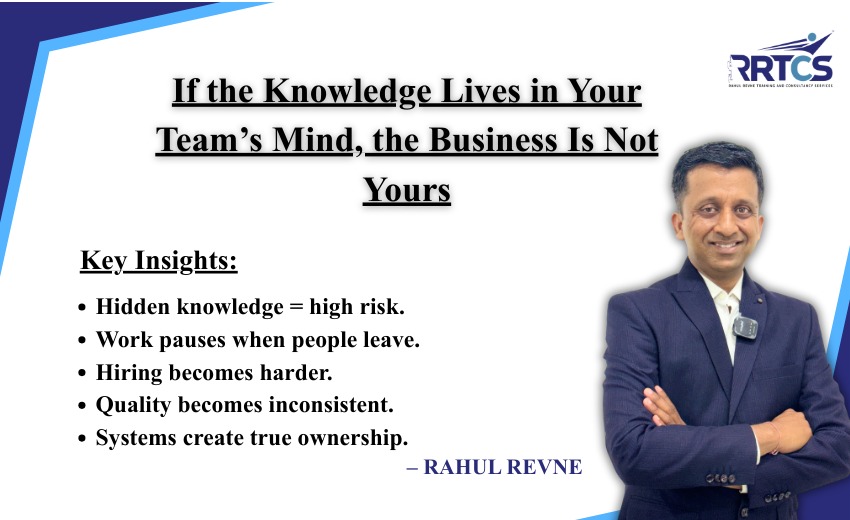
If the Knowledge Lives in Your Team’s Mind, the Business Is Not Yours

RRTCS has analysed this pattern while working with many businesses across industries, and one critical truth keeps appearing:If your business knowledge exists only in your team’s memory and not in documented systems, you don’t own the business — your employees do. The Hidden Risk: Undocumented Knowledge In many companies: No processes are written No SOPs exist No record of key clients and their importance No notes on client behaviour, preferences, or decision patterns No supplier communication history Everything runs on memory and personal experience.It works — until the day it doesn’t. This creates a single point of failure inside the business. The Moment a Key Employee Leaves The real risk becomes visible when one key person: resigns goes on long leave becomes unavailable Suddenly: Work stops Clients don’t get responses Follow-ups break Supplier relationships weaken New opportunities are lost The team becomes confused And the most dangerous loss: client trust. At that moment the owner realizes: “The business was not running on a system. It was running on a person.” Ask Yourself These 5 Strategic Questions Think about your most critical employee and ask: If they stop working tomorrow, what will happen? Do you know what they are currently working on? Which clients are directly dependent on them? What is their exact process for handling work? Can someone else immediately take over their role? If your answer is “No” to these,your business is in high operational risk. Person-Dependent vs System-Driven Business Person-Dependent System-Driven Knowledge in people’s minds Knowledge in documents Work stops when someone leaves Work continues smoothly Owner feels stressed Owner has visibility Growth is limited Business is scalable A person-dependent model is not a business — it is a fragile structure. What Should Be Done? 1. Build a Knowledge Capture System Sit with your key team members and document: Step-by-step processes Key client list with weightage Client behaviour and communication style Pricing logic Negotiation approach Common problems and solutions This is not just documentation —this is your business DNA. 2. Create SOPs for Every Repeat Task Document procedures for: Sales process Client onboarding Order execution Complaint handling Payment follow-ups So that any trained person can run the function. 3. Develop a Client Intelligence Sheet For every key client, record: Decision maker Buying triggers Payment pattern Communication preference Last discussion summary This strengthens relationships beyond individuals. 4. Create Role Backup (Shadow System) For every critical role: Assign a primary owner Assign a trained secondary backup Your business should never stop because of one absence. 5. Weekly Knowledge Transfer Meetings A 30-minute weekly session where team members share: What they are working on New learnings New risks New opportunities This builds future leaders and reduces dependency. 6. Owner-Level Strategic Visibility The owner does not need to do everything —but must have visibility into everything. Maintain a simple dashboard showing: Active deals Key client status Pending payments Major operational risks The Most Dangerous Sentence in Business “Don’t worry, he will handle it.” That sentence creates dependency,and dependency kills scalability. Your Real Business Asset Your real asset is not your office, team, or product.Your real asset is:documented knowledge + defined processes + structured data. The day your business runs smoothly without depending on one person,you move from being an operator to becoming an owner. Final Strategic Truth If knowledge lives in your team’s mind,control is not with you. When knowledge lives in systems and documents,the business truly becomes yours. 📩 Connect today to start building your systems. Book a Founder Audit to identify your business bottlenecks. Why RRTCS? At RRTCS – Rahul Revne Training & Consultancy Services, we help entrepreneurs implement Profit First frameworks by: ✅ Designing KPI-driven financial dashboards ✅ Identifying profit leakage points ✅ Building SOPs for expense control ✅ Training teams to think “Profit First” in every decision Because real growth is not about bigger sales — it is about better profits. 👉 With RRTCS, you don’t just earn more — you keep more.

Owner Time Leakage: How 2–3 Hours Get Wasted Daily Without Processes
Blog, Business Growth

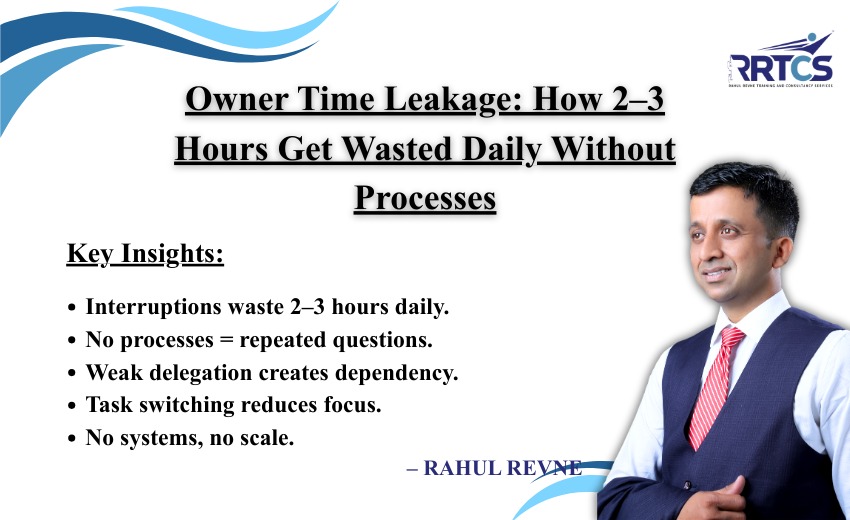
Owner Time Leakage: How 2–3 Hours Get Wasted Daily Without Processes

With 15+ years of experience and 120+ business audits, one pattern keeps showing up repeatedly —companies are not losing money first, they are leaking the owner’s time. The owner stays busy all day, but not productive. How does time leak? Where there is no process, every decision goes to the owner: Every small query → owner Every approval → owner Guidance at every step → owner One question = 10–15 minutesJust 4 questions per day = 1 hour Then add: Monitoring operations Taking follow-ups Checking updates Another 2–3 hours gone End-of-day result:👉 Busy day👉 Zero strategic output Direct financial loss of time If your 1 hour is worth ₹1500: Daily loss:👉 ₹3000 – ₹4500 Monthly loss:👉 ₹78,000 – ₹1,17,000 And this does not include lost opportunities. What are the root causes? 1. No system → Owner in firefighting mode No planningNo estimationEverything becomes urgent 2. Roles & hierarchy are unclear Who takes initiative → unclearWho can make decisions → unclearResult → owner dependency 3. No defined workflow Every task starts from scratchSetup time repeats 4. Scattered information Email, WhatsApp, spreadsheets, people’s memory —No single source of truth Every question becomes an information hunt. 3 signs you’re bleeding hours every week 1. The same questions are asked repeatedly This means there is no documentation. 2. Manual repeat work Copy-pasting data Reformatting reports Manual scheduling Small tasks → massive time loss 3. The same data exists in multiple places Confusion → delays → owner involvement The impact Important meetings get postponed Strategy work stays on hold Growth projects get delayed Owner stays busy, but business stays stagnant The solution: The owner must move from operator to architect Focus on: ✅ SOP creation✅ Clear roles & decision matrix✅ Defined workflows✅ Single data system✅ Automation of repeat tasks✅ Daily priority planning When systems are in place: 60–70% queries reduce Follow-ups become structured Reporting becomes automated 2–3 hours of owner time is freed daily And that time goes into growth. If your time is leaking… You need to build systems urgently. 📩 Connect today to build your systems. Why RRTCS? At RRTCS – Rahul Revne Training & Consultancy Services, we help entrepreneurs implement Profit First frameworks by: ✅ Designing KPI-driven financial dashboards✅ Identifying leakage points✅ Building SOPs for expense control✅ Training teams to think “profit first” in every decision Because real growth isn’t about bigger sales — it’s about better profits. 👉 With RRTCS, you don’t just earn more — you keep more.

Small Businesses need systems
Blog, Business Growth

Small Businesses need systems

A large corporation can survive a bad month. A small business often cannot survive a bad week. This is not about size — it is about systems. And yet, systems are exactly what most small business owners ignore. Most entrepreneurs believe that structured processes, SOPs, and operational frameworks are things that only big companies need. “We are a small team — we can figure it out as we go.” But this thinking is precisely what keeps small businesses stuck at the same level year after year. In a small business, the team is lean and the margin for error is thin. One person handles sales, another manages operations, and sometimes the same person does both — plus accounts, plus customer service. When there are no defined roles and no standard processes, every day becomes reactive. People work hard, but in different directions. Energy is spent figuring out what to do next, rather than actually doing it. Priorities shift constantly. Decisions depend on whoever is available. This is not an effort problem. It is a system problem — and it silently drains the business every single day. No System Means Endless Experiments Without boundaries and defined processes, every team member figures out their own way of doing things. Some approaches work. Many do not. And every failed trial costs the business time, money, and human energy it simply cannot afford to waste. A large company has the financial buffer and manpower to absorb these losses and course-correct. A small business does not. What feels like a learning experience on the surface is often just a quietly expensive mistake — one that repeats itself because nothing was documented, nothing was standardized, and nothing changed. Consistency is the Real Competitive Advantage When a system exists, work happens in a predictable, repeatable way. Quality becomes consistent across people, shifts, and situations. Customers know what to expect every time they interact with the business. Teams know exactly what to deliver and how. This consistency is not just good operations — it builds trust, strengthens brand reputation, and creates the kind of customer loyalty that no marketing budget can buy. Small businesses that compete with larger players do not win on price — they win on reliability. And reliability comes from systems, not talent alone. Here is the bigger picture, broken down simply: You cannot scale what you cannot repeat. A business that depends entirely on the owner’s presence and memory has a hard ceiling on growth. Systems remove that ceiling — they allow faster employee onboarding, better quality control, and the ability to grow beyond one person. Every process documented today is time saved tomorrow, errors avoided next month, and money protected next year. Without systems, the owner is always the bottleneck — and the business stops the moment the owner stops. For a corporate, a broken process is an inconvenience. For a small business, it can be the end. Systems are not a corporate luxury — they are the most critical investment a small business can make. Not in technology. Not in marketing. In how the work gets done, every single day, by every single person on the team. Build the system before you need it. Because by the time you feel the pain, the cost is already high. Why Choose Us?  At RRTCS, we help SME owners:  Identify and document critical business processes Build SOP frameworks across departments Train teams to follow and improve systems Create businesses that scale without chaos Because in business, talent gets you started—but systems take you to the top.   Connect with us to build your process-driven business today.

What is SOP in real business
Blog, Business Growth

Real बिज़नेस में SOP क्या होता है?

कई बिज़नेस owners गर्व से कहते हैं, “मेरी team को सब पता है क्या करना है!” लेकिन जैसे ही कोई key employee absent होता है—orders में गलती, customers की complaints, और owner को घंटों firefighting करनी पड़ती है।ऐसा क्यों? क्योंकि knowledge अगर सिर्फ किसी के दिमाग में है, तो वो system नहीं है। Processes को document करना ही पहला step है ऐसा business बनाने का जो आपके बिना भी smoothly run करे। SOP क्या है?SOP = Standard Operating Procedureयानि एक written, step-by-step guide जो बताती है कि कोई specific task हर बार, सही तरीके से, किसी भी person द्वारा कैसे किया जाए।👉 SOP सिर्फ document नहीं है, यह आपके business system की backbone है। SOP न होने पर क्या होता है?जब Ramesh (आपका best employee) sick हो जाता है:– बाकी लोग process guess करते हैं → mistakes होती हैं– orders delay या cancel होते हैं → customers complain करते हैं– owner को खुद handle करना पड़ता है → 6+ घंटे daily waste सिर्फ एक employee की absence, एक हफ्ते में ₹1 लाख+ का loss कर सकती है — सिर्फ इसलिए क्योंकि process documented नहीं था। SOP आपके business का सबसे बड़ा asset क्यों है?– Rework 50–80% तक कम होता है– New hires की training fast हो जाती है– Specific लोगों पर dependency खत्म होती है– Owner daily operations से free हो जाता है एक SOP बनाने में 4–6 घंटे लगते हैं।लेकिन उसका return? सालाना ₹7–15 लाख तक की saving। SOP बनाना कैसे शुरू करें? सबसे painful process पहले choose करें उस person से बात करें जो काम best करता है Step-by-step actions, tools और outputs लिखें New employee से test करें हर 6 महीने में review और update करें System = FreedomSOP individual knowledge को business capital में convert करता है।Strong businesses heroes पर नहीं, systems पर depend करते हैं। Why Choose Us?RRTCS में हम SME owners की help करते हैं:– Critical processes identify और document करने में– Department-wise SOP frameworks build करने में– Team को system follow और improve करने की training देने में– ऐसा scalable business बनाने में जो chaos के बिना grow करे क्योंकि business में talent आपको शुरुआत दिलाता है,लेकिन systems आपको top तक पहुंचाते हैं। Connect with us today to build your process-driven business.

Scroll to Top