
Managing growth is one of the most rewarding yet challenging phases for any entrepreneur.
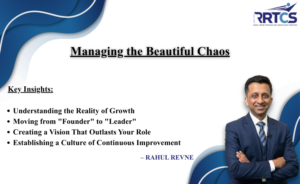
While everyone celebrates a spike in sales, the internal reality is often very different: pressure, confusion, delayed decisions, and operational chaos.
If your business is growing but you feel like you are personally losing control, this guide will help you navigate the high-growth phase with leadership and clarity.
-
Understanding the Reality of Growth
Growth is often romanticized, but in practice, it brings a new level of responsibility.
Increased Pressure
More clients mean more expectations, more communication, more delivery pressure, and more chances for mistakes.
Operational Friction
Processes that worked for 10 clients often break when the business reaches 100 clients.
What looked efficient at a small scale may become weak, slow, or confusing at a larger scale.
Constant Follow-ups
As the business grows, communication volume increases.
Without structure, the founder or leader becomes the default follow-up machine.
The goal is not just to grow.
The goal is to manage growth in a way that does not create burnout, service failure, or founder dependency.
-
Moving from Founder to Leader
In the early stages, the business often depends heavily on the owner.
The founder becomes the lead salesperson, primary decision-maker, chief problem-solver, and final approval point.
This is called the Founder Bottleneck.
To scale effectively, the founder must transition from doing everything personally to building a business that can perform through people, systems, and accountability.
From Doing to Leading
Stop executing every task yourself.
Start building the people, processes, and review systems that allow others to execute well.
Your role is not to carry every task.
Your role is to create the structure in which tasks are done correctly without your constant involvement.
Delegating Authority
Delegation is not just giving tasks to people.
Real delegation means giving people ownership, decision rights, clarity, and accountability within their area.
If your team has responsibility without authority, they will still depend on you for every decision.
-
Creating a Vision That Outlasts Your Role
High-growth periods require a clear North Star.
When things become chaotic, your team needs to know what they are building, why it matters, and how their work contributes to the larger mission.
Define the Impact
Move beyond “increasing revenue.”
Clarify the transformation you are creating for your clients, your industry, your team, and your market.
Revenue is important, but it should not be the only story your team believes in.
Build a Lasting Legacy
Aim to create systems, culture, leadership, and initiatives that continue to function even when you are not in the room.
A strong business should not depend only on the founder’s presence, memory, or pressure.
-
Establishing a Culture of Continuous Improvement
When things move fast, mistakes will happen.
The difference between a chaotic company and a mature company is how it responds to those mistakes.
Instead of looking for someone to blame, strong leaders build a data-driven improvement culture.
Audit Your Systems
Use pressure as a diagnostic tool.
When something breaks, ask:
- Was the process clear?
- Was the owner defined?
- Was the handover proper?
- Was the review rhythm missing?
- Was the data visible?
- Was the team trained?
Before blaming people, audit the system.
Iterate Constantly
If a customer service process fails under pressure, do not just fix that one customer issue.
Fix the system that allowed the issue to happen.
Every repeated mistake is a signal that the process needs improvement.
Choose Clarity Over Chaos
Use financial visibility, defined controls, clear roles, dashboards, and review rhythms to convert unmanaged growth into sustainable expansion.
- Clarity reduces panic.
- Systems reduce dependency.
- Review creates accountability.
Real Scale Is About Handling More
Growth does not automatically solve your existing problems.
It often multiplies them.
- If follow-ups are weak at 10 clients, they will become a crisis at 100.
- If roles are unclear with 5 employees, they will become chaos with 50.
- If cash flow is not visible at a small scale, growth can make the risk even bigger.
Sustainable success is built on strong systems and a leadership mindset that values stability as much as speed.
Build the foundation first.
Then growth becomes stronger, calmer, and more scalable.