
Author name: lakod

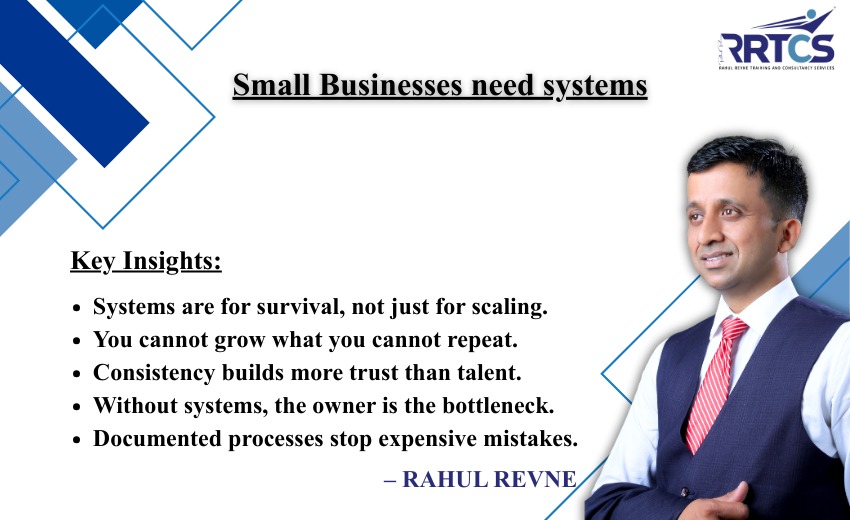
Small Businesses need systems
Blog, Business Growth

Small Businesses need systems

A large corporation can survive a bad month. A small business often cannot survive a bad week. This is not about size — it is about systems. And yet, systems are exactly what most small business owners ignore. Most entrepreneurs believe that structured processes, SOPs, and operational frameworks are things that only big companies need. “We are a small team — we can figure it out as we go.” But this thinking is precisely what keeps small businesses stuck at the same level year after year. In a small business, the team is lean and the margin for error is thin. One person handles sales, another manages operations, and sometimes the same person does both — plus accounts, plus customer service. When there are no defined roles and no standard processes, every day becomes reactive. People work hard, but in different directions. Energy is spent figuring out what to do next, rather than actually doing it. Priorities shift constantly. Decisions depend on whoever is available. This is not an effort problem. It is a system problem — and it silently drains the business every single day. No System Means Endless Experiments Without boundaries and defined processes, every team member figures out their own way of doing things. Some approaches work. Many do not. And every failed trial costs the business time, money, and human energy it simply cannot afford to waste. A large company has the financial buffer and manpower to absorb these losses and course-correct. A small business does not. What feels like a learning experience on the surface is often just a quietly expensive mistake — one that repeats itself because nothing was documented, nothing was standardized, and nothing changed. Consistency is the Real Competitive Advantage When a system exists, work happens in a predictable, repeatable way. Quality becomes consistent across people, shifts, and situations. Customers know what to expect every time they interact with the business. Teams know exactly what to deliver and how. This consistency is not just good operations — it builds trust, strengthens brand reputation, and creates the kind of customer loyalty that no marketing budget can buy. Small businesses that compete with larger players do not win on price — they win on reliability. And reliability comes from systems, not talent alone. Here is the bigger picture, broken down simply: You cannot scale what you cannot repeat. A business that depends entirely on the owner’s presence and memory has a hard ceiling on growth. Systems remove that ceiling — they allow faster employee onboarding, better quality control, and the ability to grow beyond one person. Every process documented today is time saved tomorrow, errors avoided next month, and money protected next year. Without systems, the owner is always the bottleneck — and the business stops the moment the owner stops. For a corporate, a broken process is an inconvenience. For a small business, it can be the end. Systems are not a corporate luxury — they are the most critical investment a small business can make. Not in technology. Not in marketing. In how the work gets done, every single day, by every single person on the team. Build the system before you need it. Because by the time you feel the pain, the cost is already high. Why Choose Us?  At RRTCS, we help SME owners:  Identify and document critical business processes Build SOP frameworks across departments Train teams to follow and improve systems Create businesses that scale without chaos Because in business, talent gets you started—but systems take you to the top.   Connect with us to build your process-driven business today.
What is SOP in real business
Blog, Business Growth

Real बिज़नेस में SOP क्या होता है?

कई बिज़नेस owners गर्व से कहते हैं, “मेरी team को सब पता है क्या करना है!” लेकिन जैसे ही कोई key employee absent होता है—orders में गलती, customers की complaints, और owner को घंटों firefighting करनी पड़ती है।ऐसा क्यों? क्योंकि knowledge अगर सिर्फ किसी के दिमाग में है, तो वो system नहीं है। Processes को document करना ही पहला step है ऐसा business बनाने का जो आपके बिना भी smoothly run करे। SOP क्या है?SOP = Standard Operating Procedureयानि एक written, step-by-step guide जो बताती है कि कोई specific task हर बार, सही तरीके से, किसी भी person द्वारा कैसे किया जाए।👉 SOP सिर्फ document नहीं है, यह आपके business system की backbone है। SOP न होने पर क्या होता है?जब Ramesh (आपका best employee) sick हो जाता है:– बाकी लोग process guess करते हैं → mistakes होती हैं– orders delay या cancel होते हैं → customers complain करते हैं– owner को खुद handle करना पड़ता है → 6+ घंटे daily waste सिर्फ एक employee की absence, एक हफ्ते में ₹1 लाख+ का loss कर सकती है — सिर्फ इसलिए क्योंकि process documented नहीं था। SOP आपके business का सबसे बड़ा asset क्यों है?– Rework 50–80% तक कम होता है– New hires की training fast हो जाती है– Specific लोगों पर dependency खत्म होती है– Owner daily operations से free हो जाता है एक SOP बनाने में 4–6 घंटे लगते हैं।लेकिन उसका return? सालाना ₹7–15 लाख तक की saving। SOP बनाना कैसे शुरू करें? सबसे painful process पहले choose करें उस person से बात करें जो काम best करता है Step-by-step actions, tools और outputs लिखें New employee से test करें हर 6 महीने में review और update करें System = FreedomSOP individual knowledge को business capital में convert करता है।Strong businesses heroes पर नहीं, systems पर depend करते हैं। Why Choose Us?RRTCS में हम SME owners की help करते हैं:– Critical processes identify और document करने में– Department-wise SOP frameworks build करने में– Team को system follow और improve करने की training देने में– ऐसा scalable business बनाने में जो chaos के बिना grow करे क्योंकि business में talent आपको शुरुआत दिलाता है,लेकिन systems आपको top तक पहुंचाते हैं। Connect with us today to build your process-driven business.

What is SOP in real business
Blog, Business Growth

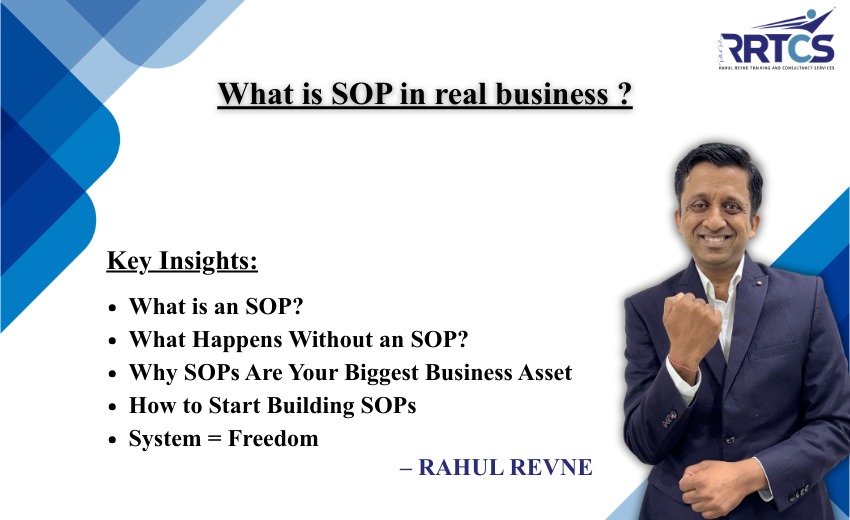
What is SOP in real business

Many business owners proudly say, “My team knows what to do!” But when a key employee is absent—orders go wrong, customers complain, and the owner spends hours firefighting. Why? Because knowledge in someone’s head is not a system. Documenting your processes is the first step to building a business that runs without you. What is an SOP? SOP = Standard Operating Procedure. It is a written, step-by-step guide that explains exactly how a specific task should be done—every time, by anyone. 👉 But an SOP is not just a document—it is the backbone of your business system. What Happens Without an SOP? When Ramesh (your best employee) falls sick: Others guess the process → mistakes happen Orders get delayed or cancelled → customers complain Owner steps in → loses 6+ hours  One absent employee can cost you ₹1 lakh+ in a single week—just because the process was not documented. Why SOPs Are Your Biggest Business Asset Reduces rework by 50–80% Cuts training time for new hires Removes dependency on specific people Frees the owner from daily operations  One SOP takes 4–6 hours to build. The return? ₹7–15 lakh saved annually.  How to Start Building SOPs  Pick your most painful process first Interview the person who does it best Write step-by-step actions with tools and outputs Test it with a new employee Review and update every 6 months System = Freedom SOPs convert individual knowledge into business capital.  The strongest businesses don’t depend on heroes—they depend on processes. Why Choose Us?  At RRTCS, we help SME owners:  Identify and document critical business processes Build SOP frameworks across departments Train teams to follow and improve systems Create businesses that scale without chaos Because in business, talent gets you started—but systems take you to the top.   Connect with us to build your process-driven business today.
Case Study

Case Study – IT, Software & Digital Services

Case Study: IT, Software & Digital Services Industry: IT, Software & Digital Services Case Study Snapshot This engagement focused on moving away from third-party tools and hardware-based systems toward customized, real-time digital systems and proactive financial planning. Situation Before Engagement Recruitment & Workforce Management Reliance on traditional job portals and local recruitment agencies Physical biometric attendance machines No structured work-from-home management No defined training methodology Project & Operations Management Dependency on third-party task management software (Todoist) Office assets purchased without long-term planning Informal or non-existent documentation and leave policies Financial & Strategic Planning No financial reserve planning Limited cash flow visibility Interventions Implemented Recruitment & Workforce Management Expanded talent sourcing through Social Media platforms such as LinkedIn Replaced biometric machines with an On-Desk Attendance System integrated into internal communication chat Implemented a structured Work From Home protocol with dedicated systems Introduced Real-time Training Methods Resulted in 6 employees becoming fully independent 7 employees entered the structured training pipeline within 4 months Project & Operations Management Replaced third-party tools with a custom-built Project Management System Enabled domain-wise tracking for web development and design tasks Introduced Long-term Future Planning for asset acquisition Implemented a standardized Leave Policy with sandwich leave and emergency clauses Financial & Strategic Planning Implemented a reserve strategy to save one year’s advance office rent Introduced a protocol to prepare income details 15 days in advance Overall Impact Reduced dependency on external tools and hardware Improved workforce productivity and training efficiency Enhanced operational visibility and control Strengthened financial stability and forward planning Created scalable, customized digital systems

Case Study

Case Study – Financial Services & Co-operative Society

Case Study: Financial Services & Co-operative Society Industry: Financial Services & Co-operative Society Case Study Snapshot This engagement focused on the complete digitization of administrative and financial workflows to improve transparency, tracking, and decision-making. Situation Before Engagement Human Resources & Talent Acquisition Basic, non-standard recruitment application forms Reliance on newspaper classifieds for hiring No formal induction process Manual or informal leave tracking Operational & Inventory Management Manual stock registers No real-time inventory visibility Manual quotation comparison processes Financial Tracking & Account Management Manual vendor ledger entries No centralized financial oversight or dashboard Interventions Implemented Human Resources & Talent Acquisition Implemented a Standard Recruitment Policy Introduced professional Personal Data Sheets Started using Job Portals and Social Media platforms for hiring Established a formal induction process Implemented a digital Leave Management System Operational & Inventory Digitization Introduced a digital Inventory Management & Stock Reporting system Enabled real-time stock tracking and instant report downloads Implemented a digital Quotation Management system Financial Tracking & Account Management Implemented a digital Vendor Payments Tracker Created a centralized Accounts Management Dashboard Enabled searchable and auditable financial records Transformation After Implementation HR processes became standardized and digital Inventory and procurement processes became transparent and traceable Financial data became centralized, searchable, and auditable Overall Impact Complete digitization of core operations Improved transparency and accountability Faster and more informed decision-making through real-time data

Case Study

Case Study – Technical Services & Pump Solutions

Case Study: Technical Services & Pump Solutions Industry: Technical Services & Pump Solutions Case Study Snapshot This engagement focused on standardizing documentation, strengthening financial discipline, and enabling international business expansion. Situation Before Engagement Standardization of Documentation No formal induction, leave, or recruitment policies Internal communication largely oral and informal No standard SOPs, JDJS, or dispatch tracking formats Process & Cultural Gaps No formal recognition or celebration practices No structured guest welcome protocols No defined meeting or scheduling rules Financial & Strategic Management No budget planning Manual recovery processes No ratio analysis for monitoring financial health No advance planning for creditor payments Business Growth No international exposure No quality certifications Limited physical infrastructure Interventions Implemented Documentation & Communication Implemented Induction, Leave, Working Hours, and Recruitment policies Shifted internal communication to written email-based communication Introduced standardized SOPs, JDJS, and Dispatch Data Trackers Process & Cultural Implementation Introduced Farewell Gift Ceremonies and Award Celebrations Implemented the Happiness Sharing initiative (bell culture) Established structured Guest Welcome protocols Developed indoor and outdoor plantation plans Introduced Google Calendar for meeting scheduling Financial & Strategic Management Implemented department-wise budget planning Started using Tally Mobile for faster recovery tracking Introduced Current Ratio and Quick Ratio analysis Planned creditor payments two months in advance Business Growth & Global Outreach Achieved ISO 9001:2015 Certification Participated in BAUMA Exhibition, China Engaged with Chinese manufacturing companies Secured large-quantity international orders Purchased a new shop Established separate offices for different departments Transformation After Implementation Complete standardization of policies and documentation Improved internal discipline and professional communication Strong financial visibility and control established International business exposure and credibility achieved Infrastructure aligned with current and future scale Overall Impact Shift from informal operations to corporate governance Improved financial health monitoring and planning Enabled international expansion Strengthened organizational culture and professionalism

Case Study

Case Study – Water Treatment & Engineering

Case Study: Water Treatment & Engineering Industry: Water Treatment & Engineering Case Study Snapshot This engagement focused on transforming an organization from unorganized internal functioning into a structured, professionally managed business with measurable systems and reporting discipline. Situation Before Engagement Human Resources & Employee Engagement No formal induction or joining process No structured training modules Training limited to random technical sessions No employee benefit or engagement schemes Limited company resources with only 1–2 vehicles Operational & Sales Management No Daily Operations Management (DOM) No Monthly Sales or Service Review mechanism No MIS reporting for payments or customer profiling Absence of a structured leadership hierarchy Marketing & Digital Presence Only individual LinkedIn profiles Less than 200 followers No planned or consistent digital communication strategy Interventions Implemented Human Resources & Employee Engagement Implemented a structured Induction Plan and Training Modules Introduced a Joining Kit for all new employees Launched SEED (Skill Enhancement Employee Development) Program Included detailed day plans Personality development sessions Live demonstrations Started Provident Fund (PF) contributions Introduced employee engagement initiatives such as: Birthday celebrations Presentation role-plays Formal employee recognition Expanded company resources to 3 “Launchers” with dedicated drivers Operational & Sales Management Implemented DOM (Daily Operations Management) Introduced Monthly Sales and Service Review meetings Enabled target vs. actual sales tracking and strategic planning Established formal MIS reporting for payments and customer profiling Introduced a Guest Welcome culture Created territory-wise leadership structure with shadowing processes for second-line managers Marketing & Digital Presence Created a professional company LinkedIn page Built a structured one-year posting plan Increased followers to over 1,400 Transformation After Implementation HR processes became structured, consistent, and scalable Employee engagement and professionalism increased significantly Sales and operations became measurable and review-driven Leadership depth and second-line management were established Brand visibility and digital presence improved substantially Overall Impact Shift from unorganized functioning to professional systems Improved employee safety, output, and engagement Better sales tracking, reporting, and strategic planning Strong foundation created for scalable and sustainable growth

Business Growth, Finance

Cash Flow vs. Profit: What Every Entrepreneur Must Understand

Many entrepreneurs proudly say, “My business is profitable!” But when it’s time to pay salaries, vendors, or taxes—they feel the cash crunch. Why? Because profit and cash flow are not the same. Understanding the difference is the first step to building a financially strong and scalable business. 1. What is Profit? Profit = Revenue – Expenses.It shows how much money is left after covering all costs.👉 But profit is on paper—it reflects accounting, not necessarily money in hand. 2. What is Cash Flow? Cash Flow = Actual movement of money in and out of business.It includes: 3. Why Profitable Companies Still Go Bankrupt 4. How to Manage Cash Flow Effectively ✅ Track receivables & follow up consistently✅ Negotiate better credit terms with vendors✅ Avoid overstocking✅ Keep emergency cash reserves✅ Review Cash Conversion Cycle (CCC) monthly 5. Profit + Cash Flow = True Health Profit ensures long-term success.Cash flow ensures daily survival.👉 The healthiest businesses balance both. Why RRTCS? At RRTCS – Rahul Revne Training & Consultancy Services, we help entrepreneurs:✅ Build KPI-driven financial dashboards✅ Track both profit & cash flow✅ Identify leakages and inefficiencies✅ Create financial discipline across teams Because in business, profit is theory, but cash flow is reality. 👉 Choose RRTCS to master both—and scale without financial stress.

Business Growth

The 5-Step Formula to Scale an MSME into a Crore+ Business

Every MSME owner dreams of crossing the crore mark—whether in revenue, profit, or valuation. But most get stuck in day-to-day firefighting and never build a business that scales. Scaling isn’t about working harder; it’s about following a structured formula. Here are 5 proven steps to take your MSME from survival mode to a crore+ business. Step 1: Clarity of Vision & Numbers Step 2: Build Systems & SOPs Step 3: Develop a Self-Managed Team Step 4: Focus on Profitable Growth Step 5: Invest in Branding & Market Expansion Why RRTCS? At RRTCS – Rahul Revne Training & Consultancy Services, we specialize in helping MSMEs scale to the crore+ level with:✅ Vision planning workshops✅ SOPs & KPI dashboards✅ Team leadership systems✅ Profit-first financial strategies✅ Branding & growth roadmaps Because scaling is not luck—it’s a formula. 👉 With RRTCS, you don’t just dream of a crore+ business—you build one

Business Growth

Profit First: How to Increase Profits Without Increasing Sales

Most entrepreneurs chase sales numbers, believing revenue growth will automatically bring profit. But in reality, sales don’t guarantee profits—sometimes they even increase losses. The smart approach is Profit First—a philosophy that focuses on protecting and growing profits before chasing higher sales. 1. The Myth of “Sales Solve Everything” 2. How “Profit First” Works Instead of Sales – Expenses = Profit, flip the formula:Sales – Profit = Expenses 3. Ways to Increase Profit Without Increasing Sales ✅ Cut Waste & Leakage – Audit unnecessary costs, rework, pilferage.✅ Increase Efficiency – Optimize operations, streamline processes.✅ Price Smartly – Revise pricing to reflect value, not just cost.✅ Focus on High-Margin Products – Sell more of what gives better margins.✅ Cash Flow Discipline – Monitor receivables, payables, and stock holding. 4. The Cultural Shift When you adopt Profit First thinking: 5. Why Profit First Matters for MSMEs For MSMEs, cash flow is oxygen. Sales growth without profit discipline often leads to: 👉 Profit First ensures stability, peace of mind, and sustainable scaling. Why RRTCS? At RRTCS – Rahul Revne Training & Consultancy Services, we help entrepreneurs implement Profit First frameworks by:✅ Designing KPI-driven financial dashboards✅ Identifying leakage points✅ Building SOPs for expense control✅ Training teams to think “profit first” in every decision Because real growth isn’t about bigger sales—it’s about better profits. 👉 With RRTCS, you don’t just earn more—you keep more

Scroll to Top