
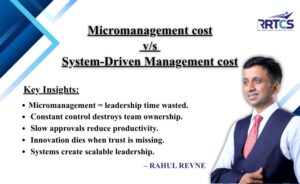
In many organizations, one common but damaging management mistake continues to exist — micromanagement.
Many managers believe that closely monitoring every task helps maintain control and ensures high standards. However, in reality, this management style often slows down organizational growth.
A leader’s role is not to supervise every small task. The real responsibility of leadership is to focus on strategy, vision, and long-term growth. But when leaders become deeply involved in operational details, their focus shifts from strategic thinking to daily control.
This is why modern management thinking is increasingly moving from micromanagement to system-driven management.
What Is Micromanagement?
Micromanagement is a management style in which a manager closely observes and controls the work of employees.
Common signs of micromanagement include:
- Constantly asking for updates
- Difficulty delegating tasks
- Requiring approval for every decision
- Rewriting or excessively correcting employees’ work
- Dependence on individuals instead of processes
Managers often adopt this approach to maintain quality and avoid mistakes, but the results are often the opposite of what they expect.
The Real Cost of Micromanagement
The cost of micromanagement is not only emotional or cultural — it also has a direct business impact.
1. Misuse of Leadership Time
When leaders involve themselves in every operational detail, they spend time on work that team members are capable of doing themselves.
This leads to:
- Less focus on strategy
- Reduced innovation
- Missed growth opportunities
A successful leader should spend time creating direction, not executing every task.
2. Decline in Team Motivation
When employees are constantly monitored, they begin to feel that:
- Their manager does not trust them
- Their capabilities are being questioned
- They do not have the freedom to work independently
Research highlights the seriousness of the issue:
- 85% of professionals reported that micromanagement negatively impacted their morale
- 71% said it interfered with their job performance
- 69% considered leaving their jobs because of micromanagement
- 36% actually changed jobs
When employees are not given ownership of their work, they stop taking initiative and simply follow instructions.
3. Slower Productivity
Micromanagement also slows down workflow.
This happens because:
- Every decision requires approval
- Employees hesitate to take initiative
- Feedback loops become longer
As a result, a project that should take 10 hours may end up taking 20 hours.
4. Creativity and Learning Are Suppressed
Micromanagement leaves little room for experimentation.
However, business growth depends heavily on:
- Experimentation
- Problem-solving
- Innovation
When employees are constantly controlled, they become cautious and avoid trying new approaches. Over time, the organization loses its innovative edge.
The Root Cause of Micromanagement
Micromanagement usually arises due to two key reasons:
- Lack of trust
- Lack of systems
Managers often believe that if they do not personally check everything, mistakes will happen.
But the real issue is often not the employees — it is the absence of clear systems and processes.
The Solution: A System-Driven Management Model
The most effective solution to micromanagement is adopting a system-driven business model.
In this model, a business operates not on the constant involvement of individuals but on well-defined systems and processes.
This includes:
- Standard Operating Procedures (SOPs)
- Defined workflows
- Automation tools
- Accountability checkpoints
- Clear roles and responsibilities
When systems are well designed, managers do not need to monitor every step.
How a System-Driven Model Eliminates Micromanagement
1. Roles and Processes Are Clearly Defined
In a system-driven organization, every task has:
- Clear steps
- A responsible person
- A defined outcome
This reduces confusion and minimizes the need for constant supervision.
2. Monitoring Without Micromanaging
System-driven management does not eliminate supervision, but it shifts the focus.
Instead of controlling every small activity, managers review performance at predefined checkpoints.
Examples include:
- Performance dashboards
- Automated reports
- Periodic reviews
This allows leaders to stay informed without interfering with daily execution.
3. Leaders Save Time
Strong systems free leaders from operational overload.
As a result, leaders can focus on:
- Strategy
- Expansion opportunities
- Innovation
- Long-term planning
This is why large and successful organizations rely heavily on systems rather than individuals.
Advantages of a System-Driven Business Model
Scalability
When processes are repeatable, businesses can grow faster without depending on a single individual’s time and energy.
Operational Consistency
Standardized workflows create consistent results and a reliable customer experience.
Reduced Owner Dependency
A well-designed system allows the business to run smoothly even when the owner is not involved in every decision.
Faster Employee Onboarding
New employees can quickly adapt because processes are already documented and structured.
Greater Efficiency and Growth Potential
Automation and structured systems enable businesses to operate more efficiently and open opportunities for expansion.
The New Formula for Effective Leadership
In modern organizations, leadership must shift its focus from control to systems and from supervision to empowerment.
Micromanagement may reduce short-term mistakes, but it damages long-term growth.
System-driven management, on the other hand:
- Allows leaders to think strategically
- Empowers teams to take ownership
- Creates scalable and sustainable businesses
Micromanagement often begins with good intentions, but over time it harms productivity, organizational culture, and innovation.
To build a sustainable business, leaders must move away from trying to control every task and instead focus on creating strong systems.
Because in the long run, successful businesses are not built on individuals — they are built on systems that allow people to perform at their best.
If you want to understand the bottlenecks in your business and identify what is slowing down your decisions, book your Founder Audit today.
Why RRTCS?
At RRTCS – Rahul Revane Training & Consultancy Services, we help entrepreneurs implement the Profit First framework in their businesses:
✅ Designing KPI-driven financial dashboards
✅ Identifying profit leakage points
✅ Creating SOPs for expense control
✅ Training teams to think “Profit First” in every decision
Because real growth does not come from bigger sales alone —
it comes from better profits.
👉 With RRTCS, you do not just earn more — you save more as well.