
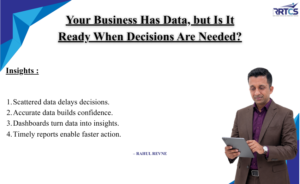
Most businesses today do not suffer from a lack of data.
- Sales figures are available.
- Purchase records are maintained.
- Inventory is recorded.
- Customer details are stored.
- Employee performance is tracked.
- Finance data is regularly updated.
Yet, when the business owner asks a simple question—“Which product is giving us the highest profit?” or “Why did sales decline this month?”—the answer is often not immediately available.
Someone must first check an Excel file. Someone else must search through WhatsApp messages. Another person must verify the figures with the accounts department. After several calls, follow-ups, and corrections, management finally receives the report.
But by that time, the decision may already be delayed.
The real problem is not the absence of data. The problem is that the data is not decision-ready.
Having Data Is Not the Same as Having Information
Raw data tells you what has been recorded. Decision-ready information tells you what is happening, why it is happening, and where action is required.
For example:
- “Sales this month were ₹25 lakh” is data.
- “Sales are ₹5 lakh below target because conversions declined in two territories” is decision-ready information.
Similarly:
- “Inventory worth ₹40 lakh is available” is data.
- “₹8 lakh of inventory has not moved for more than 90 days and is blocking working capital” is decision-ready information.
Data becomes useful only after it has been verified, organised, compared, and presented with the right context. As IBM explains, important dimensions of data quality include accuracy, completeness, consistency, timeliness, validity, and uniqueness.
A business may have thousands of entries, but if they are incomplete, outdated, or inconsistent, they cannot support a reliable decision.
The Hidden Cost of Scattered Data
In many MSMEs, information is spread across multiple places:
- Sales figures are maintained by the sales team.
- Payment details are available with accounts.
- Stock information is recorded by the store department.
- Customer follow-ups remain in individual WhatsApp chats.
- Production updates are maintained in registers.
- Employee performance is known mainly through verbal feedback.
Each department may have its own version of the truth.
As a result, management meetings spend more time debating numbers than solving problems. Instead of asking, “What action should we take?” people keep asking, “Which figure is correct?”
This creates several hidden costs:
- Decisions are delayed.
- Problems are identified too late.
- Employees spend hours preparing reports.
- Different departments present conflicting figures.
- Business owners become dependent on particular individuals for information.
- Decisions are influenced by assumptions instead of facts.
Bad or incomplete data does not merely create reporting problems—it weakens decision-making and execution. Harvard Business Review has highlighted how poor-quality data wastes time, increases costs, and makes effective execution more difficult.
What Makes Data Decision-Ready?
Decision-ready data does not necessarily require expensive software or a complex Business Intelligence system. It requires discipline and structure.
Every important business number should answer five questions:
- Is it accurate?
The figures should reflect what has actually happened. If sales, dispatch, payment, and inventory records do not match, management cannot trust the report.
- Is it available on time?
A perfectly accurate report received after the decision is required has limited value.
A production-delay report prepared at the end of the month cannot prevent delays that are occurring today. An overdue-payment report reviewed once in three months cannot protect cash flow effectively.
- Is it easy to access?
Important information should not depend on one employee’s availability or remain hidden across multiple files and messages.
The relevant people should know where the latest and approved information is available.
- Is someone responsible for it?
Every report or important metric needs a clear owner.
Who will enter the data?
Who will verify it?
Who will analyse it?
When must it be updated?
When ownership is unclear, data collection becomes irregular and errors remain uncorrected.
- Does it lead to action?
A dashboard should not merely display numbers. It should highlight gaps, trends, exceptions, and priorities.
If sales are below target, where is the shortfall?
If costs have increased, which expense is responsible?
If inventory is rising, which material is not moving?
If productivity is falling, in which process is the delay occurring?
The purpose of reporting is not to produce more reports. It is to make the next action clear.
Dashboards Should Reduce Questions, Not Create More of Them
A well-designed dashboard gives management one trusted view of the business.
It does not need to display every available number. It should show the few indicators that influence important decisions, such as:
- Target versus actual sales
- Enquiry-to-order conversion
- Gross margin
- Receivables and overdue payments
- Inventory movement
- Production status
- Customer complaints
- Employee or department performance
- Major gaps requiring immediate action
Dashboards can help convert scattered data into useful insights, but technology alone cannot solve the problem. If incorrect data is entered, even the most attractive dashboard will show incorrect conclusions.
First create a disciplined process for data collection, verification, ownership, and review. Then use technology to make that process faster.
Build a Data-Ready Business
MSME owners can begin with a few practical steps:
- Identify the most important decisions made every week and every month.
- Determine which numbers are required for those decisions.
- Create one standard format and one trusted source for each number.
- Assign responsibility for entering and verifying the information.
- Decide a clear reporting frequency—daily, weekly, or monthly.
- Review trends and gaps, not only final totals.
- End every review with an action, an owner, and a deadline.
The goal is not to collect more data. The goal is to make the right data available when it can still influence the outcome.
A business becomes truly data-driven not when it owns many files, registers, or dashboards, but when its leaders can quickly understand the situation and confidently decide what to do next.
Data becomes valuable only when it is accurate, accessible, and available in time to support a decision.
________________________________________________________________________________________
Author Bio
Mr. Rahul Revne Founder of RRTCS (Rahul Revne Training & Consultancy Services), Mr. Rahul Revne brings over 15 years of experience in HR, Sales, Strategy, and end-to-end business consulting.
Known for turning struggling ventures into thriving enterprises, he helps entrepreneurs master the art of meaningful customer connection, emotional intelligence in sales, and purpose-driven business growth. Author of Entrepreneurial Series and Spirit of Inspiration, Mr. Revne continues to empower leaders with clarity, courage, and customer focus.