
In many MSMEs, business owners and senior leaders remain occupied with customers, sales, operations, finance, and urgent problem-solving. Because their schedules are full, they often manage their teams through quick instructions:
“Complete this today.”
“Speak to the customer.”
“Correct this report.”
The instruction may be clear to the leader—but is it equally clear to the employee?
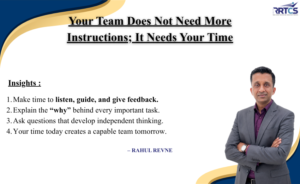
Giving instructions may help complete today’s task, but it does not necessarily prepare an employee to handle tomorrow’s responsibilities independently. For that, your team needs something more valuable: your time.
An Unavailable Leader Creates Invisible Problems
When leaders are rarely available, employees may know what they have to do, but not:
- Why the task is important
- What result is expected
- How to handle exceptions
- Which decisions they can take independently
- When they should ask for help
This creates communication gaps, repeated mistakes, delayed decisions, and dependency.
Employees may start waiting for approval even for small matters. Some avoid asking questions because the leader always appears busy. Others make assumptions that may result in costly errors.
Eventually, the leader becomes frustrated:
“Why does my team need me for everything?”
But sometimes the answer is simple: the team was given instructions, but it was never given enough guidance to develop independent thinking.
Instructions Tell People What to Do. Conversations Teach Them How to Think.
There is an important difference between assigning work and developing people.
An instruction says:
“Prepare this report by Friday.”
A developmental conversation explains:
“This report will help us identify delayed orders. Include the reason for each delay so that we can decide what action to take. How are you planning to collect this information?”
The second approach may require a few extra minutes, but it helps the employee understand the purpose, expected quality, and thought process behind the task.
Over time, such conversations improve judgment. Employees begin to understand how their leader evaluates situations and makes decisions. As their thinking develops, their dependency decreases.
Your Availability Determines Whether Employees Speak Up
A team does not become open simply because the leader says, “You can approach me anytime.”
Employees observe the leader’s behaviour. Does the leader listen patiently? Are questions welcomed or treated as interruptions? Can employees admit mistakes without being blamed?
Google’s research on team effectiveness identified psychological safety—feeling safe to ask questions, admit mistakes, and offer ideas—as an important characteristic of effective teams. It also highlighted the importance of structure and clarity. (Google re:Work)
If employees fear the leader’s reaction, they may hide problems until they become serious. A production delay, customer complaint, quality issue, or material shortage could have been solved earlier—if someone had felt comfortable raising it.
Feedback Should Not Wait
Many leaders provide feedback only when something goes wrong. As a result, employees begin to associate every conversation with criticism.
Effective feedback should be timely, specific, and focused on improvement.
Instead of saying:
“This work is not good.”
Say:
“The information is correct, but the report does not show the reason for the delay. Add that column, and confirm the format before starting next time.”
Gallup reports that regular, meaningful feedback is connected with stronger employee engagement and performance. (Gallup)
Feedback does not always require a long meeting. A focused five-minute conversation at the right time can prevent the same mistake from being repeated for months.
Giving Time Is Not Micromanagement
Giving time does not mean monitoring every action or solving every problem for employees. The purpose is not to make them more dependent—it is to make them more capable.
Instead of immediately giving answers, leaders can ask:
- What result are you trying to achieve?
- What is stopping you?
- What options have you considered?
- What will you do differently next time?
- What support do you need from me?
These questions encourage employees to think, solve problems, and take ownership.
A Simple Practice for Busy Leaders
Employee development does not require hours of daily meetings. Start with a simple system:
- Hold a 15–20-minute weekly check-in with key team members.
- Explain the purpose and expected result behind important tasks.
- Give feedback while the situation is still fresh.
- Ask employees to suggest solutions before giving them answers.
- Complete your own promised approvals and follow-ups on time.
The Real Return on a Leader’s Time
Giving time to employees may initially feel like it is taking you away from “important work.” In reality, it is one of the most important responsibilities of a leader.
The time you invest today can reduce tomorrow’s corrections, follow-ups, escalations, and repeated explanations. It creates employees who understand the business, take responsibility, make better decisions, and require less supervision.
A leader who only completes personal tasks may remain a strong performer. But a leader who develops capable people builds a stronger organisation.
Your team may not need another instruction or reminder. It may need ten focused minutes with you—ten minutes to understand, ask, learn, and improve.
Because leadership is not only about completing the work in front of you. It is about developing the people who will carry the organisation forward.
Instructions may complete a task. Your time develops a team.
_________________________________________________________________________________________
Author Bio
Mr. Rahul Revne Founder of RRTCS (Rahul Revne Training & Consultancy Services), Mr. Rahul Revne brings over 15 years of experience in HR, Sales, Strategy, and end-to-end business consulting.
Known for turning struggling ventures into thriving enterprises, he helps entrepreneurs master the art of meaningful customer connection, emotional intelligence in sales, and purpose-driven business growth. Author of Entrepreneurial Series and Spirit of Inspiration, Mr. Revne continues to empower leaders with clarity, courage, and customer focus.