
Many business owners believe that if their product is excellent, customers will automatically buy it. They invest heavily in quality, features and technical improvements.
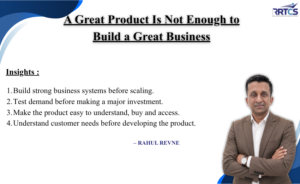
Product quality is important—but it alone cannot build a successful business.
A business must also understand:
- Who is the right customer?
- What problem does the product solve?
- How should it be priced and positioned?
- How will customers learn about and access it?
- Why should they choose it over other options?
A product may be technically excellent, but if customers do not understand its value or cannot purchase it easily, it will struggle to generate sales.
A Successful Business Needs Two Things
Every successful business must create a valuable product and build an effective system to promote, sell, deliver and improve it.
If a company focuses only on product quality, it may create something customers do not need or are unwilling to pay for.
If it focuses only on marketing and sales, a weak product may generate initial orders—but it will eventually lead to complaints, low repeat business and a poor reputation.
Long-term growth happens when product quality and business development work together.
Understand the Customer Before Developing
Many product decisions are based on assumptions such as:
“Customers will definitely like this.”
“This new feature will increase sales.”
Before investing heavily, speak with potential customers. Understand their problems, priorities, budget and buying behaviour.
Ask:
- What problem are they currently facing?
- How are they solving it today?
- What do they dislike about the available options?
- Which features are genuinely useful?
- What may stop them from purchasing?
These conversations can prevent the business from investing in ideas that do not create real customer value.
Test Before Investing Fully
A new idea should first be tested on a small scale.
Create a sample, prototype, trial version or limited quantity and share it with selected customers. Their feedback can help identify problems before a major investment is made.
However, appreciation should not be confused with demand. Customers may call a product “good,” but the real question is whether they are willing to pay for it.
An actual order, advance payment or repeat purchase is stronger proof than positive comments.
Build a Commercially Practical Product
While developing a product, the business must consider both quality and commercial practicality.
Even an excellent product may fail if:
- Its cost makes the final price too high
- It takes too long to manufacture or deliver
- Customers find it difficult to use
- The sales team cannot explain its value
- It requires more service than the business can provide
- Dealers do not receive a reasonable margin
The aim is not simply to create the best possible product. It is to create the right product for the right customer at a workable price.
Make the Value Easy to Understand and Access
Customers do not buy technical features simply because they exist. They buy when they understand how the product will help them.
The business must clearly explain:
- What problem the product solves
- What benefits the customer will receive
- How it is different from other options
- Why customers should trust it
The buying process must also be simple. Enquiries should receive timely responses, quotations should be clear, and delivery promises should be realistic.
A great product creates value. A strong business system makes that value accessible.
Keep Learning and Improving
Product development does not end after the launch. Real learning begins when customers start using the product.
Management should regularly review:
- Customer feedback and complaints
- Reasons for lost sales
- Returns and repeat orders
- Delivery and service problems
- Product profitability
Repeated feedback should be discussed by product, production, sales and service teams. Sometimes the product needs improvement. At other times, the real problem may be pricing, communication, delivery or targeting the wrong customers.
Scale Only When the Foundation Is Strong
Before increasing production or entering new markets, check whether:
- Product quality is consistent
- Customers are satisfied
- Demand is repeatable
- Profit margins are healthy
- Delivery and service systems can manage higher volumes
Scaling a weak product or an unorganised process only increases complaints, costs and pressure.
First make the business model work. Then make it bigger.
__________________________________________________________________________________
A good product gives customers a reason to buy. A good business system gives them the confidence and convenience to complete the purchase and return in the future.
Product quality, customer understanding, pricing, positioning, sales, delivery and continuous improvement must work together.
Great products create customer value. Great businesses ensure that customers can understand, access and consistently experience that value.
_________________________________________________________________________________________
Author Bio
Mr. Rahul Revne Founder of RRTCS (Rahul Revne Training & Consultancy Services), Mr. Rahul Revne brings over 15 years of experience in HR, Sales, Strategy, and end-to-end business consulting.
Known for turning struggling ventures into thriving enterprises, he helps entrepreneurs master the art of meaningful customer connection, emotional intelligence in sales, and purpose-driven business growth. Author of Entrepreneurial Series and Spirit of Inspiration, Mr. Revne continues to empower leaders with clarity, courage, and customer focus.