
Many founders believe that more products mean more opportunities.
A customer asks for something new, so we add it.
A competitor enters another category, so we enter it too.
Sales are slowing, so we introduce more products.
Gradually, the business starts doing a little bit of everything.
But there is a hidden cost.
More products can mean more inventory, more processes, more priorities, more training, more quality issues—and more decisions coming back to the founder.
The Law of Contraction, discussed in The 22 Immutable Laws of Branding by Al Ries and Laura Ries, presents a powerful idea:
A brand can become stronger when it narrows its focus.
For an MSME, however, this is not only a branding principle.
It can also be an execution principle.
When Focus Becomes an Operational Advantage
Imagine a manufacturing company producing 20 different product variations.
Each variation requires different raw materials, production instructions, quality checks, pricing, inventory planning and sales knowledge.
The founder may think:
“We have more products, so we can serve more customers.”
But inside the organization, something different may be happening.
The Purchase team is managing too many materials.
Production keeps changing priorities.
Salespeople are unclear about which products to push.
Quality becomes inconsistent.
Inventory increases.
And employees repeatedly approach the founder for decisions.
Now imagine the company identifies the few product categories where it has the strongest demand, margins and capabilities—and starts focusing its resources there.
Suddenly, the business can build clearer processes around fewer priorities.
The team becomes better at producing them.
Sales communication becomes sharper.
Quality standards become easier to define and measure.
And most importantly, customers start understanding:
“This is what this company is known for.”
That is where brand focus and operational focus meet.
The FOCUS Diagnostic
Before adding another product, service or business priority, founders can use a simple framework:
F — Fit
Does this offering fit what we want our brand to be known for?
O — Opportunity
Is there proven customer demand, or are we adding it simply because competitors are doing it?
C — Capability
Do we have the people, processes and expertise to deliver it consistently?
U — Unit Economics
Does it generate healthy revenue and margins after considering the operational complexity it creates?
S — System
Can the team execute it through defined processes, ownership and measurable standards—or does the founder have to personally manage it?
If an offering fails repeatedly across these questions, adding it may create more complexity than growth.
Questions Every Founder Should Ask
Take a look at your current business:
- Which products or services generate most of your profitable business?
- What do customers currently know your company for?
- Which offerings create unnecessary operational complexity?
- Are your teams working on too many priorities at the same time?
- Do your most important products have clearly defined SOPs, owners, quality standards and KPIs?
- If you reduced your priorities, could your team execute the remaining ones better?
These questions shift the discussion from simply “What else can we sell?” to:
“What should we become exceptionally good at?”
Focus Must Be Visible in Execution
Narrow positioning alone is not enough.
If you decide to focus on a particular offering, that focus should become visible throughout the organization.
- Sales targets should reflect it.
- Processes should support it.
- Employees should know their responsibilities.
- Quality should be measured.
- Reviews should track the right numbers.
- And accountability should be clearly assigned.
Otherwise, “focus” remains another strategy written on paper.
The real advantage appears when the organization can execute that focus consistently without depending on the founder for every decision.
Doing Less Can Help You Become Known for More
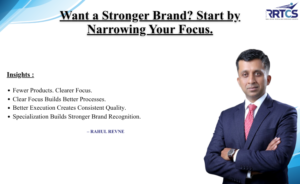
Growth does not always require adding something new.
Sometimes, the next stage of growth starts by identifying what creates the greatest value—and removing the distractions around it.
- Fewer priorities.
- Clearer processes.
- Better quality.
- Stronger accountability.
- Sharper market recognition.
The objective is not simply to become smaller.
It is to become more focused, more systematic and better at execution.
If you want to understand where unnecessary complexity, unclear priorities or founder dependency may be affecting your business, the RRTCS Business Analysis can help identify the gaps across leadership, systems and execution.
If you want to identify the leadership and system gaps keeping your business founder-dependent, message me “Business Analysis.”
_________________________________________________________________________________________
Author Bio
Mr. Rahul Revne Founder of RRTCS (Rahul Revne Training & Consultancy Services), Mr. Rahul Revne brings over 15 years of experience in HR, Sales, Strategy, and end-to-end business consulting.
Known for turning struggling ventures into thriving enterprises, he helps entrepreneurs master the art of meaningful customer connection, emotional intelligence in sales, and purpose-driven business growth. Author of Entrepreneurial Series and Spirit of Inspiration, Mr. Revne continues to empower leaders with clarity, courage, and customer focus.
To know more visit our website : www.rrtcs.com