
Many MSME founders believe they need to develop stronger leaders in their organization.
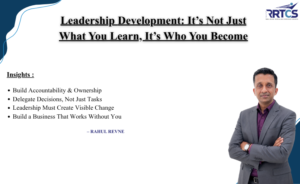
So, they send managers to training programs. They introduce leadership frameworks. They conduct workshops on communication, delegation, and decision-making.
But a few months later, the founder is still approving every important decision.
Employees still go directly to the founder when there is a problem.
Department heads still wait for instructions.
And the founder still says:
“If I don’t get involved, things don’t move.”
This is where we need to ask an important question:
Did leadership development actually happen—or did leadership learning happen?
Leadership Development Must Create Visible Change
Learning a new leadership concept is useful. But in a business, leadership development should eventually become visible in day-to-day execution.
A developing leader should gradually be able to:
- Make defined decisions without repeatedly seeking the founder’s approval.
- Delegate work with clear responsibility and timelines.
- Hold team members accountable for agreed results.
- Review numbers instead of depending only on verbal updates.
- Take ownership when something goes wrong.
- Develop team members who can handle responsibilities independently.
If these behaviours are not changing, more training alone may not solve the problem.
Consider a Simple Example
Imagine a manufacturing company where the founder has appointed a Production Head.
The Production Head has experience and has attended management training. But whenever production is delayed, material is unavailable, or an urgent order comes in, the same pattern occurs:
“Sir, what should we do?”
The founder makes the decision.
Over time, the team learns something unintentionally:
Responsibility may belong to the department head, but decisions still belong to the founder.
Now imagine the company creates a clearer system.
The Production Head has defined decision-making authority. Certain decisions can be made independently. Exceptions have clear escalation rules. Production KPIs are reviewed weekly. Delays require reasons and corrective actions. Responsibilities are documented.
Now leadership development is no longer limited to training.
It is connected to authority, systems, accountability and measurable execution.
A Simple Diagnostic: L.E.A.D.
Founders can assess leadership development through four areas:
L — Leadership Authority
Do your leaders know which decisions they can make independently?
E — Execution
Can they convert decisions into actions without continuous follow-up from you?
A — Accountability
Do they take responsibility for outcomes, or only report problems upward?
D — Development of Others
Are they building capable team members below them, or becoming another bottleneck?
A leadership program can teach these ideas.
A strong organizational system makes them part of everyday work.
Ask Yourself These Questions
Look at your organization and consider:
- How many decisions still come to me that my department heads should be making?
- If I am unavailable for one week, which departments will slow down?
- Do my managers have clearly defined authority along with their responsibilities?
- Are leadership expectations connected to KRAs, KPIs and regular reviews?
- When something goes wrong, do leaders bring only the problem—or also possible solutions and corrective actions?
- Are my managers creating ownership in their teams, or is everything ultimately coming back to me?
Your answers may reveal whether the challenge is really a lack of leadership knowledge—or a lack of leadership systems.
From Learning to Leadership
Leadership development should not end when the training session ends.
It should become visible in the organization:
Knowledge → Awareness → Practice → Behaviour Change → Ownership → Results
The goal is not simply to create managers who know more about leadership.
The goal is to build leaders who can make decisions, delegate effectively, create accountability, develop their teams and execute consistently.
And for founders, one of the clearest signs of leadership development may be this:
The business can handle more decisions without waiting for you.
That is when leadership development begins contributing to a less founder-dependent and more system-driven organization.
Want to understand where your business stands?
RRTCS Business Analysis can help identify gaps in leadership, decision-making, accountability, delegation and business systems that may be keeping the organization dependent on the founder.
If you want to identify the leadership and system gaps keeping your business founder-dependent, message me “Business Analysis”.
________________________________________________________________________________________
Author Bio
Mr. Rahul Revne Founder of RRTCS (Rahul Revne Training & Consultancy Services), Mr. Rahul Revne brings over 15 years of experience in HR, Sales, Strategy, and end-to-end business consulting.
Known for turning struggling ventures into thriving enterprises, he helps entrepreneurs master the art of meaningful customer connection, emotional intelligence in sales, and purpose-driven business growth. Author of Entrepreneurial Series and Spirit of Inspiration, Mr. Revne continues to empower leaders with clarity, courage, and customer focus.
To know more visit our website : www.rrtcs.com