
Most business owners do not suffer from a shortage of ideas.
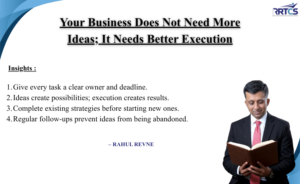
They already have ideas for increasing sales, launching products, improving customer service, reducing costs, implementing technology, creating SOPs, and building a stronger team.
These ideas are discussed in meetings, written in notebooks, and shared in WhatsApp groups. But after a few weeks, many of them disappear.
Not because the ideas were bad—but because no one converted them into clear actions.
An idea creates possibility, but execution creates results.
The Cycle of Unfinished Ideas
A business owner attends a seminar, studies a competitor, speaks with a consultant, or discovers a new tool. Immediately, a new initiative begins:
“We should implement a CRM.”
“We need to start digital marketing.”
“We should create SOPs.”
“We need to improve employee performance.”
For a few days, the team discusses the idea enthusiastically. Then daily operations take over. Customer complaints, delayed payments, production issues, and urgent sales targets demand attention.
Slowly, the new initiative moves into the background.
Before it is completed, another idea arrives—and the same cycle begins again.
The result is a business with many started initiatives but very few completed improvements.
A Decision Is Not an Execution Plan
One common mistake in founder-led businesses is assuming that once something has been discussed, it will automatically happen.
Consider the difference:
“We need to improve sales follow-up” is an intention.
“From Monday, every sales executive will update all pending enquiries in the CRM by 6:00 p.m., and the sales manager will review the report every morning” is an execution plan.
The second statement defines the action, responsible person, deadline, and review system.
Execution begins only when an idea is converted into specific work.
Why Good Ideas Fail
- Too Many Priorities
When everything is important, nothing receives enough attention.
If the owner introduces several initiatives together, employees naturally focus on what appears most urgent or what the founder follows up on most frequently.
Instead of continuously adding new goals, select two or three important priorities and complete them properly.
- No Clear Owner
Statements such as “Sales will handle it,” “HR will look into it,” or “The team will complete it” create weak accountability.
Every important action needs one clearly identified owner. Others may provide support, but one person must be responsible for completion.
- No Clear Action Plan
“Improve customer service” is a goal, but it does not tell employees what to do differently.
It should be converted into actions:
- Record every complaint
- Assign a responsible employee
- Define a resolution timeline
- Follow up with the customer
- Review repeated complaints every week
When the next action is unclear, work is delayed.
- No Specific Deadline
A task without a deadline remains a suggestion.
“Complete it soon” or “Start it next month” creates no clear commitment. Every task should have a specific completion date. Larger projects should also have milestone dates.
- No Regular Follow-Up
Many tasks fail because they are assigned once and reviewed much later.
Regular follow-up does not mean micromanagement. It means reviewing progress, delays, obstacles, and the next action at a fixed time.
McKinsey identifies accountability, coordination, capabilities, and motivation as important elements of strong execution. These elements help organizations convert vision into measurable results. Read the McKinsey insight.
- Activity Is Mistaken for Progress
Meetings, reports, calls, and messages can make a team appear busy, but they do not always produce results.
If the goal is to increase sales conversion, do not measure only the number of calls. Measure:
- Follow-ups completed
- Proposals submitted
- Conversion ratio
- Revenue generated
Execution should be measured through outcomes, not only activities.
The Hidden Cost of Poor Execution
Poor execution affects more than one project.
Over time:
- Employees stop taking new initiatives seriously.
- Managers wait for repeated reminders.
- Important work becomes dependent on the founder.
- Time and money are spent without producing results.
- The team stays busy but the business does not progress.
- Priorities keep changing before results are achieved.
Eventually, the organization develops a culture where decisions are discussed but not completed.
A Simple Execution System for MSMEs
MSMEs do not always need complicated software or lengthy frameworks. A simple execution system can begin with seven questions:
- What result do we want?
Define a specific and measurable outcome. - Why is it important?
Connect it with sales, profitability, productivity, quality, customer service, or cash flow. - What actions are required?
Divide the goal into smaller steps. - Who will own each action?
Assign every action to one person. - By when will it be completed?
Set a specific deadline. - How will success be measured?
Decide what evidence or number will prove progress. - When will it be reviewed?
Fix a daily, weekly, fortnightly, or monthly review schedule.
A basic execution tracker can include:
| Priority | Action | Owner | Deadline | Success Measure | Status |
| Improve sales conversion | Review all pending quotations | Sales Manager | 28 August | 100% reviewed | In Progress |
| Reduce complaints | Start complaint register | Service Head | 25 August | Every complaint recorded | Not Started |
The value of this tracker does not come from its design. It comes from reviewing and updating it consistently.
The Founder’s Role in Execution
The founder does not need to perform every task, but must create an environment where important work gets completed.
This means:
- Setting limited and clear priorities
- Assigning responsibility
- Providing the required resources
- Removing obstacles
- Reviewing progress regularly
- Asking for evidence instead of verbal updates
- Holding people accountable for commitments
Execution is not only an operational responsibility. It is a leadership responsibility.
Before Introducing Your Next Idea
Before launching another initiative, ask:
- What important initiatives are already running?
- Who owns each one?
- What was supposed to be completed?
- What has actually been completed?
- What is delaying progress?
- Do we need a new idea—or do we need to finish the existing one?
Sometimes, the best growth decision is not introducing another strategy. It is completing the strategy the business has already selected.
Your business may already have enough ideas to reach its next level.
What it needs is the discipline to select the right ideas, assign clear ownership, review progress, and complete them properly.
Because in business, the winning idea is rarely the one that sounds most impressive.
It is the one that gets executed.
________________________________________________________________________________________
Author Bio
Mr. Rahul Revne Founder of RRTCS (Rahul Revne Training & Consultancy Services), Mr. Rahul Revne brings over 15 years of experience in HR, Sales, Strategy, and end-to-end business consulting.
Known for turning struggling ventures into thriving enterprises, he helps entrepreneurs master the art of meaningful customer connection, emotional intelligence in sales, and purpose-driven business growth. Author of Entrepreneurial Series and Spirit of Inspiration, Mr. Revne continues to empower leaders with clarity, courage, and customer focus.