
Running a growing business means managing many moving parts.
Sales, inventory, finance, customer service, delivery, reporting, and follow-ups all need to work together.
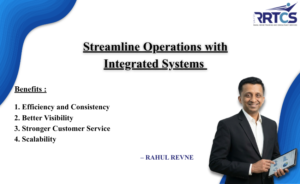
An integrated business system, such as an ERP or CRM, connects these functions so your business does not depend on scattered spreadsheets, manual updates, and guesswork.
When data flows smoothly between departments, errors reduce, time is saved, and decisions become clearer.
More importantly, you get a real-time view of your business — inventory levels, cash flow, customer orders, pending payments, sales performance, and service issues — all in one place.
This helps you identify trends quickly and make decisions based on facts, not assumptions.
Why Businesses Need Integrated Systems
Disconnected tools slow down growth.
For example, if sales orders are tracked in one system and inventory is tracked somewhere else, mistakes can happen.
Orders may be missed. Stock may run out. Finance may not get updated on time. Customers may receive delayed responses.
An integrated system solves this by connecting key business functions.
When a sale happens, inventory updates automatically. Finance gets visibility. Customer service can see the order status. Management can review performance through reports.
This reduces manual data entry, improves coordination, and frees your team from repeated follow-ups.
It also creates consistent and accurate reports, making budgeting, planning, and decision-making easier.
Key Benefits of Integrated Business Systems
1. Efficiency and Consistency
Automated workflows replace repetitive manual tasks such as invoicing, stock updates, reminders, and reporting.
This reduces errors, delays, and dependency on individual memory.
2. Better Visibility
Dashboards give you quick visibility into important numbers such as sales, expenses, inventory, receivables, customer issues, and team performance.
When numbers are visible, decisions become faster and more accurate.
3. Stronger Customer Service
When customer data is available in one place, your team can respond faster, track history, resolve issues better, and personalize communication.
This improves customer experience and trust.
4. Scalability
As your business grows, the system can handle more orders, more employees, more products, and more locations without creating unnecessary chaos.
A good system helps the business grow without depending only on the founder’s daily involvement.
Getting Started with an Integrated System
1. Map Your Processes
List your core workflows, such as:
-
Lead to sale
-
Sales to cash
-
Inventory management
-
Purchase process
-
Customer service
-
Billing and collections
-
Reporting and review
Then identify what the system must handle.
2. Choose the Right Tool
- Not every ERP or CRM is right for every business.
- Small and medium businesses can start with cloud-based systems that are affordable, flexible, and easier to implement.
- Evaluate tools based on your industry, team size, budget, process complexity, and future growth plans.
3. Prepare Your Data
- Before migration, clean your existing data.
- Customer lists, product details, pricing, stock records, financial data, and pending orders should be accurate and organized.
- Good data creates good decisions.
- Poor data creates confusion.
4. Train Your Team
- A system works only when people use it properly.
- Train your team with demos, practice sessions, simple guides, and clear expectations.
- Adoption is as important as implementation.
Actionable Takeaways
Start by identifying your biggest operational pain point.
-
Is it double data entry?
-
Missing information?
-
Delayed reports?
-
Inventory mismatch?
-
Weak follow-ups?
-
Unclear cash flow?
Once you identify the pain point, check how a unified system can solve it.
Involve your employees early. Ask them where delays, confusion, and repeated work happen. Their feedback will help you choose and implement a system that solves real problems.
Use reporting features from the beginning.
Set up a few key dashboards, such as:
-
Monthly sales vs. target
-
Pending receivables
-
Inventory status
-
Customer complaints
-
Lead conversion
-
Cash flow position
A modern business system is not only for large companies.
Small and medium businesses can also gain major benefits by connecting data, automating routine tasks, reducing errors, and improving decision-making.
Next Step
Need help choosing or implementing the right business system?
Contact us for a system audit or consultation.
We can help you identify the gaps, select the right solution, and make your operations smoother, clearer, and more scalable.
Author Bio
Mr. Rahul Revne Founder of RRTCS (Rahul Revne Training & Consultancy Services), Mr. Rahul Revne brings over 15 years of experience in HR, Sales, Strategy, and end-to-end business consulting.
Known for turning struggling ventures into thriving enterprises, he helps entrepreneurs master the art of meaningful customer connection, emotional intelligence in sales, and purpose-driven business growth. Author of Entrepreneurial Series and Spirit of Inspiration, Mr. Revne continues to empower leaders with clarity, courage, and customer focus.