
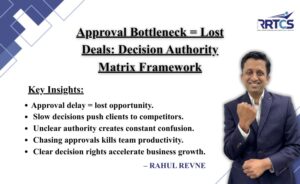
Approval Bottleneck = Lost Deals
In any organization, speed of decision-making is extremely important. Many times businesses do not lose deals because their product is poor or their price is high. They lose deals because the decision was not made on time.
When the approval process becomes slow and work gets stuck with one person, it creates what is called an approval bottleneck.
If the authority to make decisions lies with only one person, and that person is busy, unavailable, or occupied with other tasks, the entire process stops. The direct impact of this is on business — deals get delayed or move to competitors.
This is why organizations must create a clear Decision Authority Matrix.
What is an Approval Bottleneck?
An approval bottleneck occurs when approvals themselves become the biggest obstacle in completing work.
This situation usually happens when:
- Every small or large task requires approval
- Multiple people must approve one after another
- It is not clear who has the final decision authority
In such situations, employees spend less time doing actual work and more time chasing approvals.
Why Do Approval Bottlenecks Happen?
- The “Too Many Cooks” Problem (Excessive Hierarchy)
In many organizations, the approval process becomes so long that work cannot move forward quickly.
Sequential Sign-offs
Sometimes a proposal needs approval from a manager, then finance, then legal, and finally senior management.
If even one person delays the process, the entire workflow stops.
Over-Centralized Authority
When all decisions must go through senior leadership, their capacity becomes the speed limit of the organization.
Lack of Clear Ownership
If it is not clear who has the final authority to make a decision, requests keep moving between departments and decisions keep getting delayed.
- Manual and Disconnected Processes
Many organizations still rely on emails or chat messages for approvals.
Email Approvals
Approval requests often get lost in crowded inboxes or go unnoticed.
Lack of Visibility
Without a proper tracking system, employees must constantly follow up for approvals.
Incomplete Information
If a request is missing important information, it has to be sent again. This adds unnecessary steps and delays.
- Behavioral and Cultural Factors
Sometimes the bottleneck is not caused by systems but by organizational culture.
Unavailability of Approvers
If a key decision-maker is on leave or too busy, the entire workflow stops.
Risk Aversion
Some organizations create multiple layers of checking even for small decisions.
Approval Inflation
Routine tasks also require unnecessary approvals, which increases delays.
The Impact of Approval Bottlenecks
Approval delays affect several areas of an organization.
Lost Opportunities
If decisions are not made quickly, deals may move to competitors.
Reduced Productivity
Employees spend more time chasing approvals instead of doing meaningful work.
Employee Frustration
Frequent delays demotivate employees and create frustration.
Financial Loss
Delays in vendor payments may lead to penalties and damage business relationships.
The Solution: Decision Authority Matrix
To avoid approval bottlenecks, organizations should create a Decision Authority Matrix.
This means clearly defining:
- Who can make decisions at which level
- In which situations approvals are required
- Who needs to be informed
Example
Suppose there is a sales team.
|
Amount |
Decision Authority |
|
Up to ₹5,000 |
Salesperson |
|
₹5,000 – ₹25,000 |
Sales Manager |
|
Above ₹25,000 |
Senior Management |
This allows the sales team to make quick decisions for smaller deals without waiting for senior approval every time.
Frameworks for Clear Decision-Making
Organizations often use structured frameworks to clarify roles and responsibilities in decision-making.
- The RACI Framework
RACI is a responsibility matrix that clarifies roles in a project or task.
RACI Components
Responsible
The person who performs the task.
Accountable
The person who makes the final decision and is responsible for the result.
Consulted
People whose advice or expertise is needed.
Informed
People who should be kept updated about the decision.
RACI helps reduce confusion and ensures smoother execution.
- The DACI Framework
The DACI framework simplifies the decision-making process.
DACI Roles
Driver
The person who manages the decision process.
Approver
The person who makes the final decision.
Contributors
Experts who provide suggestions and insights.
Informed
People who need to be notified about the decision.
This framework is especially useful for complex projects and cross-functional teams.
How to Reduce Approval Bottlenecks
- Automate Workflows
Use digital tools to automate approval processes.
- Delegate Authority
Allow team members to make smaller decisions within defined limits.
- Define Approval Timelines
Set clear timelines for approvals.
- Enable Parallel Approvals
If possible, allow departments to review requests in parallel instead of sequentially.
In today’s competitive business environment, slow decisions can be very costly.
Approval bottlenecks slow down organizational growth and can even result in lost deals.
Every organization should therefore:
- Create a Decision Authority Matrix
- Clearly define roles and responsibilities
- Simplify and speed up the approval process
When decision authority is clear, organizations move faster, capture opportunities, and stay ahead of the competition.
Because in business, there is a simple rule:
“Companies that make faster decisions win the market.”
If you want to understand the bottlenecks in your business and identify what is slowing down your decisions, book your Founder Audit today.
Why RRTCS?
At RRTCS – Rahul Revane Training & Consultancy Services, we help entrepreneurs implement the Profit First framework in their businesses:
✅ Designing KPI-driven financial dashboards
✅ Identifying profit leakage points
✅ Creating SOPs for expense control
✅ Training teams to think “Profit First” in every decision
Because real growth does not come from bigger sales alone —
it comes from better profits.
👉 With RRTCS, you do not just earn more — you save more as well.