Case Study

Case Study

Case Study – IT, Software & Digital Services

Case Study: IT, Software & Digital Services Industry: IT, Software & Digital Services Case Study Snapshot This engagement focused on moving away from third-party tools and hardware-based systems toward customized, real-time digital systems and proactive financial planning. Situation Before Engagement Recruitment & Workforce Management Reliance on traditional job portals and local recruitment agencies Physical biometric attendance machines No structured work-from-home management No defined training methodology Project & Operations Management Dependency on third-party task management software (Todoist) Office assets purchased without long-term planning Informal or non-existent documentation and leave policies Financial & Strategic Planning No financial reserve planning Limited cash flow visibility Interventions Implemented Recruitment & Workforce Management Expanded talent sourcing through Social Media platforms such as LinkedIn Replaced biometric machines with an On-Desk Attendance System integrated into internal communication chat Implemented a structured Work From Home protocol with dedicated systems Introduced Real-time Training Methods Resulted in 6 employees becoming fully independent 7 employees entered the structured training pipeline within 4 months Project & Operations Management Replaced third-party tools with a custom-built Project Management System Enabled domain-wise tracking for web development and design tasks Introduced Long-term Future Planning for asset acquisition Implemented a standardized Leave Policy with sandwich leave and emergency clauses Financial & Strategic Planning Implemented a reserve strategy to save one year’s advance office rent Introduced a protocol to prepare income details 15 days in advance Overall Impact Reduced dependency on external tools and hardware Improved workforce productivity and training efficiency Enhanced operational visibility and control Strengthened financial stability and forward planning Created scalable, customized digital systems
Case Study

Case Study – Financial Services & Co-operative Society

Case Study: Financial Services & Co-operative Society Industry: Financial Services & Co-operative Society Case Study Snapshot This engagement focused on the complete digitization of administrative and financial workflows to improve transparency, tracking, and decision-making. Situation Before Engagement Human Resources & Talent Acquisition Basic, non-standard recruitment application forms Reliance on newspaper classifieds for hiring No formal induction process Manual or informal leave tracking Operational & Inventory Management Manual stock registers No real-time inventory visibility Manual quotation comparison processes Financial Tracking & Account Management Manual vendor ledger entries No centralized financial oversight or dashboard Interventions Implemented Human Resources & Talent Acquisition Implemented a Standard Recruitment Policy Introduced professional Personal Data Sheets Started using Job Portals and Social Media platforms for hiring Established a formal induction process Implemented a digital Leave Management System Operational & Inventory Digitization Introduced a digital Inventory Management & Stock Reporting system Enabled real-time stock tracking and instant report downloads Implemented a digital Quotation Management system Financial Tracking & Account Management Implemented a digital Vendor Payments Tracker Created a centralized Accounts Management Dashboard Enabled searchable and auditable financial records Transformation After Implementation HR processes became standardized and digital Inventory and procurement processes became transparent and traceable Financial data became centralized, searchable, and auditable Overall Impact Complete digitization of core operations Improved transparency and accountability Faster and more informed decision-making through real-time data

Case Study

Case Study – Technical Services & Pump Solutions

Case Study: Technical Services & Pump Solutions Industry: Technical Services & Pump Solutions Case Study Snapshot This engagement focused on standardizing documentation, strengthening financial discipline, and enabling international business expansion. Situation Before Engagement Standardization of Documentation No formal induction, leave, or recruitment policies Internal communication largely oral and informal No standard SOPs, JDJS, or dispatch tracking formats Process & Cultural Gaps No formal recognition or celebration practices No structured guest welcome protocols No defined meeting or scheduling rules Financial & Strategic Management No budget planning Manual recovery processes No ratio analysis for monitoring financial health No advance planning for creditor payments Business Growth No international exposure No quality certifications Limited physical infrastructure Interventions Implemented Documentation & Communication Implemented Induction, Leave, Working Hours, and Recruitment policies Shifted internal communication to written email-based communication Introduced standardized SOPs, JDJS, and Dispatch Data Trackers Process & Cultural Implementation Introduced Farewell Gift Ceremonies and Award Celebrations Implemented the Happiness Sharing initiative (bell culture) Established structured Guest Welcome protocols Developed indoor and outdoor plantation plans Introduced Google Calendar for meeting scheduling Financial & Strategic Management Implemented department-wise budget planning Started using Tally Mobile for faster recovery tracking Introduced Current Ratio and Quick Ratio analysis Planned creditor payments two months in advance Business Growth & Global Outreach Achieved ISO 9001:2015 Certification Participated in BAUMA Exhibition, China Engaged with Chinese manufacturing companies Secured large-quantity international orders Purchased a new shop Established separate offices for different departments Transformation After Implementation Complete standardization of policies and documentation Improved internal discipline and professional communication Strong financial visibility and control established International business exposure and credibility achieved Infrastructure aligned with current and future scale Overall Impact Shift from informal operations to corporate governance Improved financial health monitoring and planning Enabled international expansion Strengthened organizational culture and professionalism

Case Study

Case Study – Water Treatment & Engineering

Case Study: Water Treatment & Engineering Industry: Water Treatment & Engineering Case Study Snapshot This engagement focused on transforming an organization from unorganized internal functioning into a structured, professionally managed business with measurable systems and reporting discipline. Situation Before Engagement Human Resources & Employee Engagement No formal induction or joining process No structured training modules Training limited to random technical sessions No employee benefit or engagement schemes Limited company resources with only 1–2 vehicles Operational & Sales Management No Daily Operations Management (DOM) No Monthly Sales or Service Review mechanism No MIS reporting for payments or customer profiling Absence of a structured leadership hierarchy Marketing & Digital Presence Only individual LinkedIn profiles Less than 200 followers No planned or consistent digital communication strategy Interventions Implemented Human Resources & Employee Engagement Implemented a structured Induction Plan and Training Modules Introduced a Joining Kit for all new employees Launched SEED (Skill Enhancement Employee Development) Program Included detailed day plans Personality development sessions Live demonstrations Started Provident Fund (PF) contributions Introduced employee engagement initiatives such as: Birthday celebrations Presentation role-plays Formal employee recognition Expanded company resources to 3 “Launchers” with dedicated drivers Operational & Sales Management Implemented DOM (Daily Operations Management) Introduced Monthly Sales and Service Review meetings Enabled target vs. actual sales tracking and strategic planning Established formal MIS reporting for payments and customer profiling Introduced a Guest Welcome culture Created territory-wise leadership structure with shadowing processes for second-line managers Marketing & Digital Presence Created a professional company LinkedIn page Built a structured one-year posting plan Increased followers to over 1,400 Transformation After Implementation HR processes became structured, consistent, and scalable Employee engagement and professionalism increased significantly Sales and operations became measurable and review-driven Leadership depth and second-line management were established Brand visibility and digital presence improved substantially Overall Impact Shift from unorganized functioning to professional systems Improved employee safety, output, and engagement Better sales tracking, reporting, and strategic planning Strong foundation created for scalable and sustainable growth

Case Study

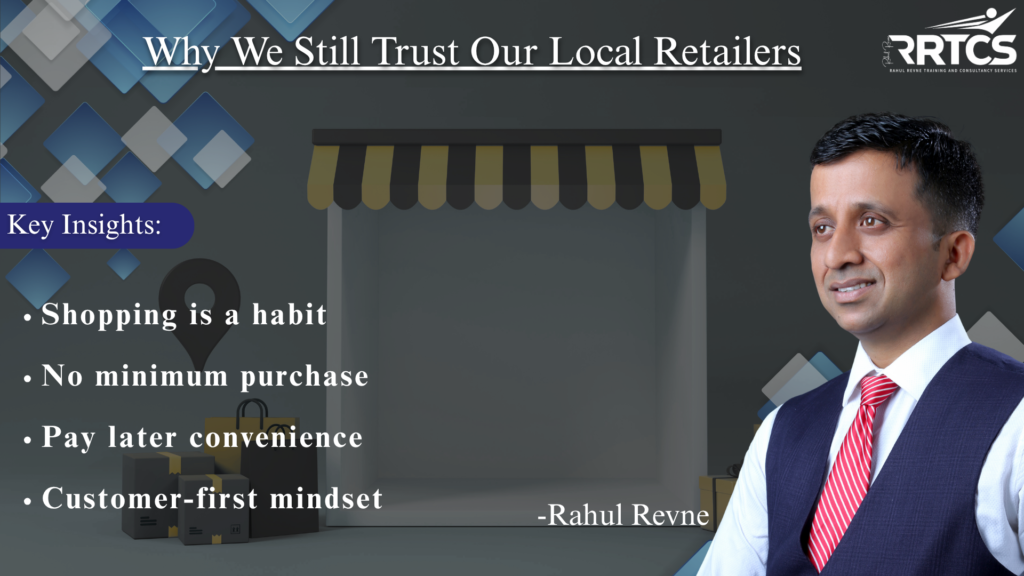
Why Local Retailers Still Outpace E-Commerce in Key Ways

💡 E-commerce is fast, convenient, and everywhere… so why are local retailers still thriving? Because they’ve mastered something online platforms can’t—human connection, flexibility, and community trust. 1️⃣ Shopping as a Habit, Not Just a Transaction For many families, visiting a local store is part of life’s rhythm. These aren’t just purchases—they’re memories. E-commerce can deliver goods, but not the warmth of these everyday rituals. 2️⃣ The “Micro-Bank” Role in Communities Local retailers often act as informal credit providers: This trust-based system is deeply personal—and something instant-payment apps simply can’t replicate. 3️⃣ Variety and Flexibility You Can’t Click E-commerce often limits your choices: Local retailers solve this. Need 10 packets of ₹10 snacks? Done. Want a rare flavor? They’ll get it for you. And they’ll deliver it faster than most apps. 4️⃣ The Magic of In-Store Discovery Online, algorithms keep showing you what you’ve already bought.Offline, your eyes wander—spotting: This kind of spontaneous discovery fuels sales and keeps shopping fun. 5️⃣ Personalized Care and Support This is where local retailers truly shine: E-commerce treats customers as transactions; retailers treat them as people. And that personal commitment is not replaceable. E-commerce will keep growing. But local retailers aren’t going anywhere.They’re evolving—leveraging trust, variety, flexibility, and real-world experiences that digital platforms can’t match. 💬 Question for you: When was the last time your local shop went the extra mile for you?

Business Growth, Case Study

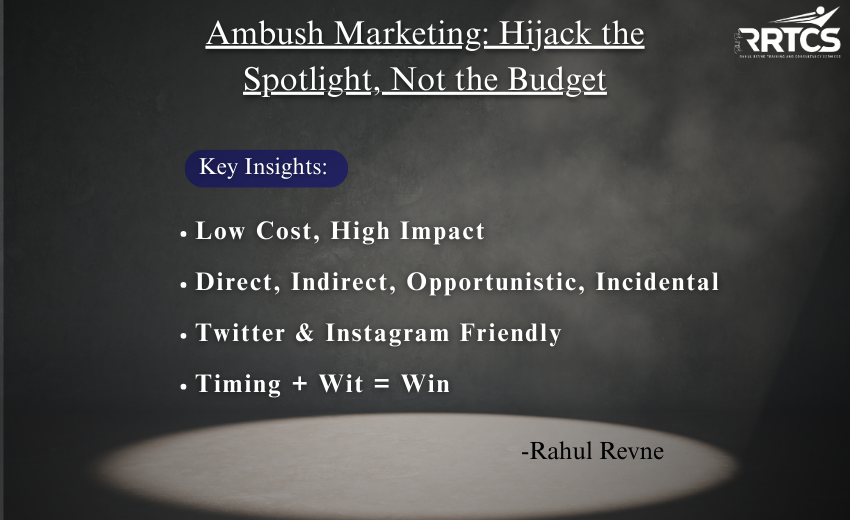
Hijack the Spotlight: The Art of Ambush Marketing

In today’s hyper-competitive market, grabbing attention isn’t always about ad budgets—sometimes, it’s about bold creativity. Welcome to ambush marketing, where brands steal the limelight with timing, wit, and zero permission. 📢 First Things First: What Is Marketing? Think of marketing as your brand’s megaphone.You might have a brilliant product—but if no one knows about it, it might as well not exist. “Good marketing makes the company look smart. Great marketing makes the customer feel smart.” – Joe Chernov That’s the trick with ambush marketing: it lets your customers feel clever for being in on it. 🚀 Why Do We Market, Anyway? Simple—because brands that don’t market, vanish. Here’s what great marketing does: Marketing helps you ride the trend—or better yet, start one. 📚 Marketing in All Its Flavors Before we deep-dive into ambush marketing, let’s look at a few standout strategies: 🕶️ So, What Is Ambush Marketing? Picture this:💃 Dancing to someone else’s music🚀 Riding the buzz from another brand’s campaign🛩️ Earning attention—without spending a dime on the spotlight Ambush marketing is unofficial, clever, and unforgettable. A rebel strategy for brands that move fast and think faster. 🎯 Types of Ambush Marketing 📌 Case Studies: When Brands Played Smart 1. Jio Hijacks VI’s Launch VI: “Bringing people together.”Jio: “Been doing that since 2016.”💡 Positioned itself as the original—without saying much. 2. Amazon Parody Roasts Zomato Zomato drops a new logo. Internet trolls it.Parody account @Aurdikhao: “Aur logo dikhado?”💡 Timing > Budget. Even a parody brand went viral. 3. Samsung Takes a Shot at OnePlus OnePlus: “The speed you need.”Samsung: “We already gave you the speed you need.”💡 Direct. Bold. Memorable. 4. Zomato’s Self-Aware Tweet Brands tweeting about other brands? Zomato quips:“Kabhi kabhi khud ka bhi tweet kar lo.”💡 Hijacked the trend of trend-hijacking. ✅ Why Ambush Marketing Works 📱 Best Played on Twitter & InstagramThese platforms love trends, speed, and sass—perfect ground for brand one-liners and visual ambushes. ⚠️ But… A Word of Caution Ambush marketing isn’t trolling for clicks.It’s about being smart, swift, and socially aware. When done right, it can create iconic brand moments—without spending a rupee on media. 💡 Pro Tips to Master the Ambush Game Don’t wait for the spotlight. Steal it—with style.

Business Growth, Case Study

The Psychology of Colors in Branding: How Colors Influence Emotions and Buying Decisions

Color is far more than a visual element—it’s a silent communicator that influences how we feel, think, and decide. In branding, the choice of color isn’t random. It’s a strategic decision designed to evoke specific emotions, create associations, and ultimately drive consumer behavior. Let’s explore how different colors shape perceptions and why some of the most successful brands rely on color psychology to make lasting impressions. 🔴 Red: The Color of Appetite and Urgency Red is bold, stimulating, and attention-grabbing. Psychologically, it evokes energy and passion—and it’s particularly effective in food and retail branding. 🔵 Blue: The Trust Builder Blue is calm, stable, and dependable. It communicates trust, intelligence, and professionalism. ⚫ Black: Sophistication and Authority Black is powerful, elegant, and timeless. It symbolizes control, prestige, and luxury. ⚪ White: Purity and Simplicity White is clean, pure, and peaceful. It gives a sense of clarity and minimalism. 💚 Green: Nature and Calm Green symbolizes growth, tranquility, and balance. It’s deeply connected with nature and health. 🟠 Orange: Energy and Enthusiasm Orange blends the cheer of yellow with the energy of red. It’s vibrant, friendly, and invigorating. 🎯 Why Color Psychology Matters in Branding Your brand’s color palette is part of its voice. It affects first impressions, strengthens brand recognition, and influences purchasing decisions—often before a single word is read. When used strategically, color becomes a branding superpower. It’s not just about looking good; it’s about feeling right. In branding, color is emotion. From McDonald’s appetite-inducing red to Apple’s minimalist black-and-white sophistication, successful companies use color to reinforce their values and connect with audiences on a deeper level.

Business Growth, Case Study

Sales with Empathy: What Customers Truly Want

In today’s fast-paced business world, where every brand is trying to sell, one truth stands tall: Customers don’t want a pitch — they want a connection. At RRTCS (Rahul Revne Training & Consultancy Services), we’ve seen businesses transform simply by changing how they engage with customers — from selling to them, to understanding with them. Here’s what modern customers truly want — and how empathetic sales can lead to real results. 1. Customers Don’t Want a Script — They Want Sincerity People can smell a scripted pitch from miles away. Whether it’s a cold call, a showroom demo, or a business presentation, customers don’t want to feel like they’re part of a rehearsed routine. Instead, they’re looking for: A sales script might help you remember key points, but genuine human interaction is what keeps the customer engaged. 2. They Want to Be Heard, Not Talked At A successful business understands that listening is selling. Customers have problems, doubts, fears, and needs. When you take the time to truly listen — without interrupting, without rushing — you begin to build trust. And trust is the currency of every sale. Ask yourself: 3. They Crave Connection, Not Just Communication In a world flooded with sales messages, ads, and popups, people are craving genuine connection. When your brand or team makes them feel seen, respected, and valued — that’s when they truly listen. Connection turns into conversation. Conversation turns into conversion. 4. Understanding Drives Influence When customers feel that you understand their world, their challenges, and what success looks like for them, they’re far more likely to choose you. Understanding means: Remember: Empathy over ego. Solutions over selling. 5. Empathy is the Ultimate Sales Strategy At RRTCS, we always say: “Sales is effective when it’s backed by empathy.” Empathy builds bridges. It shows your client that you’re not just interested in making a sale — you’re invested in solving a problem. It’s not about closing deals — it’s about opening relationships. If you want to grow your business, don’t just train your team on products. Train them on people skills. On empathy. On listening. On connection. Because the truth is simple: When customers feel heard and understood — sales become effortless. Author Bio Mr. Rahul RevneFounder of RRTCS (Rahul Revne Training & Consultancy Services), Mr. Rahul Revne brings over 20 years of experience in HR, Sales, Strategy, and end-to-end business consulting. Known for turning struggling ventures into thriving enterprises, he helps entrepreneurs master the art of meaningful customer connection, emotional intelligence in sales, and purpose-driven business growth.Author of Entrepreneurial Series and Spirit of Inspiration, Mr. Revne continues to empower leaders with clarity, courage, and customer focus.

Case Study

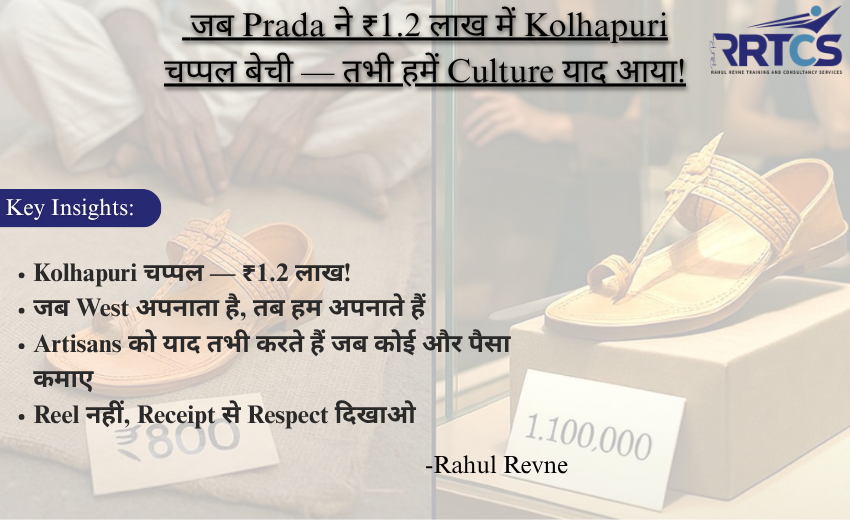
जब Prada ने Kolhapuri चप्पल ₹1.2 लाख में बेची — तब हमें Culture याद आया!

एक कड़वा सच जिसे हम अक्सर नजरअंदाज़ कर देते हैं… 🔍 क्या किया Prada ने? Luxury fashion brand Prada ने हाल ही में एक leather sandal लॉन्च किया — जो दिखने में हूबहू Kolhapuri चप्पल जैसी थी। पर असली सवाल ये है — हम खुद Kolhapuri चप्पल की इज़्ज़त कब करते हैं? क्या कभी आपने उसे गर्व से पहना? गिफ्ट किया? प्रमोट किया? 📉 वो पैटर्न जो बार-बार दोहराया जाता है: मतलब साफ है: हम अपनी ही चीज़ों को तभी क़ीमती मानते हैं जब कोई विदेशी उसे बेचे। 🔥 Prada से ज़्यादा प्रॉब्लम हमारी सोच में है: हम अपने artisans और culture को तभी याद करते हैं जब कोई outsider उनके काम से मुनाफा कमाता है। हम outrage ज़रूर करते हैं —लेकिन क्या हम local products खरीदते भी हैं? Likes से ज़्यादा ज़रूरी है Support.Reel बनाकर नहीं — receipt काटकर respect दिखाओ। 💡 अब क्या करना चाहिए? 🇮🇳 इंडिया के लिए एक मेसेज: Culture कोई seasonal trend नहीं होता —Pride एक daily habit होना चाहिए। इतना invest करो अपने कारीगरों, कलाकारों और परंपरा में किPrada जैसे ब्रांड हमारे पीछे नहीं, हमारे साथ खड़े हों। 🛑 Bottom Line: “अगर हम अपनी culture की respect नहीं करेंगे —दुनिया उसे अपने logo में बदलकर बेचेगी।” अगली बार जब कोई heritage किसी ramp पर दिखे —खुद से पूछना: “क्या मैंने उस heritage को वहां पहुंचाने में कोई भूमिका निभाई?” 🤝 अगर ये कहानी झकझोरती है… तो अगली बार outrage से पहले उत्साह दिखाओ।Order दो। Original अपनाओ। Culture को celebrate करो।

Business Growth, Case Study

Team ताश के पत्तों की तरह क्यों बिखरती है?

कभी सोचा है — कुछ टीमें प्रेशर में टूट क्यों जाती हैं, जबकि कुछ उसी प्रेशर में चमक उठती हैं? असल वजह talent नहीं होती… असल वजह होती है — क्या आपकी टीम की “basic इंसानी ज़रूरतें” पूरी हो रही हैं या नहीं। Maslow की Hierarchy और Team Building Maslow की hierarchy बताती है —पहले नींव की ज़रूरतें पूरी करनी पड़ती हैं, तभी इंसान अपनी असली potential तक पहुँच पाता है। टीम भी वैसी ही है — एक पिरामिड की तरह, नीचे से ऊपर। मैंने Maslow की सोच को टीम बिल्डिंग से जोड़ा… और जो सामने आया, वो हर लीडर को जानना चाहिए: 🧱 1. Basic Needs (Security) “जहाँ डर हो, वहाँ performance नहीं होती।” 🤝 2. Belonging Needs (Community) “जहाँ अपनापन हो, वहाँ commitment होता है।” 🏅 3. Esteem Needs (Recognition) “जहाँ सराहना हो, वहाँ excellence होती है।” 📈 4. Growth Needs (Development) “जहाँ growth हो, वहीं loyalty होती है।” 🌟 5. Self-Actualisation (Purpose) “जहाँ मकसद हो, वहाँ magic होता है।” 🚀 6. Transcendence (Leadership Beyond Self) “असली लीडर वही होता है जो और लीडर्स बनाता है।” याद रखो: Talent कम हो तो चल जाएगा,लेकिन अगर इंसान को इंसान की तरह treat नहीं किया —तो best भी average बन जाएगा। टीम बिल्ड करना है? तो pyramid के base से शुरू करो।Top पर पहुंचना अपने आप होगा। — Rahul Revne, RRTCS

Scroll to Top