
Imagine a Monday review meeting in a growing MSME.
The founder asks:
“How are we doing this month?”
“Sir, we closed three new orders last week.”
“What about the overdue payment?”
“Follow-up is going on.”
“The delayed dispatch?”
“Production is working on it.”
“Any major customer issues?”
“Nothing serious.”
What the founder doesn’t know is that the payment has crossed 75 days, the dispatch may miss another commitment, and an important customer has complained three times.
Nobody necessarily lied.
But good news arrived with numbers. Bad news arrived with soft words.
And that creates a serious leadership blind spot.
Why Does This Happen?
People are often more comfortable communicating positive information than unpleasant information—a tendency studied in communication research as the MUM Effect.
Inside a business, hierarchy can make this stronger.
Employees may fear blame. Managers may want to solve the problem before escalating it. Department heads may not want their teams to look weak.
Gradually:
“Customer is extremely unhappy”
becomes
“Customer has raised a concern”
and finally,
“Customer discussion is ongoing.”
By the time information reaches the founder, the urgency may have disappeared.
Psychological Safety Is Important—but Not Enough
Founders often say:
“My door is always open. Tell me if there is a problem.”
That’s important, but a growing organization cannot depend only on people’s willingness to speak.
It also needs systems that determine what should be reported, when it should be escalated, who owns the action and when it will be reviewed.
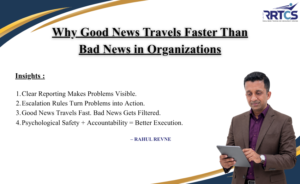
Four mechanisms can help.
- Reporting Formats
Don’t report only achievements.
Instead of:
Sales: ₹18 lakh
report:
Target: ₹25 lakh
Actual: ₹18 lakh
Gap: ₹7 lakh
Reason: ___
Action: ___
Owner: ___
Deadline: ___
A good reporting format makes gaps visible.
- Escalation Rules
Don’t leave escalation to personal judgment.
Define triggers such as:
Payment overdue > 45 days → Escalate
Customer complaint unresolved > 48 hours → Escalate
Production delay affecting committed dispatch → Escalate
Now reporting bad news becomes a business rule, not an emotional decision.
- Review Meetings
Review meetings shouldn’t only ask:
“What did we achieve?”
They should also ask:
“Where are we behind plan?”
“What has remained unresolved?”
“What could affect our next commitment?”
Every important issue should end with:
Problem → Action → Owner → Deadline → Review
- Psychological Safety
How leaders react to bad news determines whether employees will bring the next problem early—or hide it until they have no choice.
Accountability is necessary.
But accountability doesn’t have to mean fear.
First understand the issue. Then identify responsibility and corrective action.
A Quick Diagnostic for Founders
Ask yourself:
- Do I hear achievements faster than problems?
- Do our reports clearly show gaps, delays and risks?
- Does every department know when an issue must be escalated?
- Do our review meetings track unresolved problems with owners and deadlines?
- Can employees report a problem before they have the complete solution?
And most importantly:
What important information might my team currently know that I don’t?
If these questions are difficult to answer, what looks like a communication problem may actually be a system problem.
Make Reality Visible
A growing business cannot depend on the founder personally discovering every problem.
The goal is to ensure that the right information reaches the right person at the right time.
That requires:
- Clear reporting formats.
- Defined escalation rules.
- Disciplined review meetings.
- Psychological safety.
- Measurable accountability.
Because a business becomes system-driven when its systems make reality visible—and ensure that someone acts on it.
The RRTCS Business Analysis helps identify gaps across leadership, systems, accountability and execution that may be keeping the organization dependent on the founder.
If you want to identify the leadership and system gaps keeping your business founder-dependent, message me “Business Analysis ”
_________________________________________________________________________________
Author Bio
Mr. Rahul Revne Founder of RRTCS (Rahul Revne Training & Consultancy Services), Mr. Rahul Revne brings over 15 years of experience in HR, Sales, Strategy, and end-to-end business consulting.
Known for turning struggling ventures into thriving enterprises, he helps entrepreneurs master the art of meaningful customer connection, emotional intelligence in sales, and purpose-driven business growth. Author of Entrepreneurial Series and Spirit of Inspiration, Mr. Revne continues to empower leaders with clarity, courage, and customer focus.
To know more visit our website : www.rrtcs.com