
Why Great Leaders Build Systems Instead of Favourites
“A leader’s greatest responsibility is not to make everyone happy—it is to make every decision fair.”
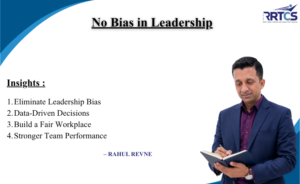
Every entrepreneur believes they are fair.
Ask any business owner, “Do you treat all your employees equally?” and the answer will almost always be yes.
But leadership bias is rarely intentional.
It happens quietly, unconsciously, and over time. If left unchecked, it becomes one of the biggest barriers to building a high-performing organisation.
________________________________________________________________________________________
The Invisible Trap of Leadership
Leadership bias doesn’t always look obvious.
It often begins with familiarity.
Imagine two employees.
One always agrees with you, communicates in a style you like, and shares your way of thinking.
The other respectfully challenges your ideas, asks difficult questions, and presents alternative viewpoints.
Without even realising it, you may begin to:
- Trust the first employee more.
- Overlook their mistakes.
- Give them more opportunities.
- Value their opinions more highly.
- Rate their performance more positively.
Not because they perform better—but because they make you feel more comfortable.
This is unconscious bias.
The danger is that leaders rarely recognise it in themselves.
_________________________________________________________________________________________
The Cost of Bias
When promotions, recognition, and opportunities are influenced by personal preference instead of performance, the entire organisation suffers.
Employees begin to think:
- “Hard work doesn’t matter.”
- “Only favourites get opportunities.”
- “My opinions are not valued.”
Over time, people stop sharing ideas.
Innovation declines.
Trust weakens.
Eventually, your best performers either disengage or leave the organisation.
The cost isn’t just losing employees—it’s losing the culture of merit that every successful business depends on.
________________________________________________________________________________________
Fairness Builds Trust
Great leaders don’t make decisions based on emotions.
They make decisions based on facts.
Instead of asking:
“Who do I enjoy working with?”
Ask:
“Who consistently delivers results, takes ownership, and lives our organisational values?”
Leadership is not about treating everyone identically.
It is about giving everyone a fair opportunity to succeed.
Employees may not always agree with your decisions, but they will respect them if they know those decisions are fair.
________________________________________________________________________________________
Replace Opinions with Systems
The best way to reduce leadership bias is to reduce subjectivity.
High-performing organisations rely on systems rather than personal opinions.
These systems include:
- Clearly defined KRAs and KPIs
- Standard Operating Procedures (SOPs)
- Structured performance reviews
- 360-degree feedback
- Transparent promotion criteria
- Data-driven decision-making
When expectations are clearly defined and performance is measurable, decisions become more objective, more transparent, and more trusted.
As management expert W. Edwards Deming famously said:
“In God we trust; all others must bring data.”
________________________________________________________________________________________
What Research Says
Research consistently shows that unconscious bias influences workplace decisions, often without leaders being aware of it. Studies published by Harvard Business Review highlight that first impressions, familiarity, and personal preferences can unconsciously affect hiring, promotions, and performance evaluations.
Gallup’s leadership research also points out that creating accountability is one of the weakest leadership competencies. Organisations that establish clear expectations and objective performance systems create stronger trust and achieve better long-term performance.
The lesson is simple:
The more your organisation depends on personal judgement alone, the greater the risk of inconsistent decisions.
________________________________________________________________________________________
A Leadership Self-Check
Ask yourself these questions:
- Do I give more opportunities to people who think like me?
- Do I judge performance based on facts or feelings?
- Would my team describe my decisions as fair?
- Can every promotion or reward be supported with measurable evidence?
- Do I encourage people to challenge my ideas without fear?
Honest answers to these questions reveal whether your leadership is driven by fairness or familiarity.
________________________________________________________________________________________
A business cannot build a culture of accountability if its leaders are influenced by personal preferences.
People don’t lose trust because leaders make difficult decisions.
They lose trust when those decisions appear inconsistent, unfair, or biased.
The strongest organisations are not built on favourites.
They are built on fairness.
When employees believe that performance—not politics—determines success, they stop competing for attention and start competing for excellence.
And that is when a business builds a culture capable of sustained growth.
________________________________________________________________________________________
Author Bio
Mr. Rahul Revne Founder of RRTCS (Rahul Revne Training & Consultancy Services), Mr. Rahul Revne brings over 15 years of experience in HR, Sales, Strategy, and end-to-end business consulting.
Known for turning struggling ventures into thriving enterprises, he helps entrepreneurs master the art of meaningful customer connection, emotional intelligence in sales, and purpose-driven business growth. Author of Entrepreneurial Series and Spirit of Inspiration, Mr. Revne continues to empower leaders with clarity, courage, and customer focus.