
One Employee Resigns… And Years of Knowledge Leave With Them.
Every business has that one employee.
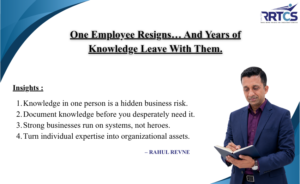
The person who has been with the organization for years. The one who knows every customer, every vendor, every process, every shortcut, and every solution. Whenever a problem arises, everybody says, “Ask him, he knows the answer.”
At first, this feels like a strength.
But hidden behind this strength is one of the biggest risks a business can create for itself.
The Dependency We Often Ignore
As founders, we appreciate experienced employees. We trust them, depend on them, and often make them the go-to person for every important task.
But very few leaders stop and ask:
What happens if this person is unavailable tomorrow?
- What if they take a long leave?
- What if they resign?
- What if an emergency forces them to step away from work?
- Will your business continue to function smoothly, or will everything suddenly slow down?
Unfortunately, many businesses discover the answer only when it is too late.
Experience Is Valuable Only When It Is Shared
An employee may spend 10 or 15 years learning how to solve customer issues, manage vendors, handle exceptions, troubleshoot problems, and make critical decisions.
Over time, they build tremendous knowledge and experience.
But where does that knowledge exist?
Is it documented anywhere?
Is it part of a system?
Or is it simply stored inside their memory?
If the answer is “inside their head,” your business is operating with hidden risk every single day.
The Cost of Undocumented Knowledge
The moment a key employee leaves, problems begin to surface.
Simple tasks become difficult.
Decision-making slows down.
Customers experience delays.
New employees struggle to learn.
And founders are forced to step back into daily operations instead of focusing on growth.
The business that once looked stable suddenly becomes fragile.
Turn Individual Knowledge Into Organizational Knowledge
Your goal should never be to replace people.
Your people are valuable.
But your business should never become dependent on one person.
Every experienced employee carries a valuable library inside their mind. Your responsibility as a leader is to convert that library into a company asset.
Start asking questions such as:
- How do you solve this problem?
- What steps do you follow every time?
- What mistakes should others avoid?
- What decisions do you take in difficult situations?
- What lessons have you learned over the years?
Then convert those answers into systems.
Create:
- SOPs (Standard Operating Procedures)
- Checklists
- Training videos
- Process maps
- Department playbooks
The goal is simple:
Don’t let one person’s experience remain one person’s experience. Make it the company’s experience.
Strong Businesses Are Built on Systems, Not Heroes
A mature business is not the one that depends on its best employee.
It is the one that can continue operating successfully even when that employee is unavailable.
So, instead of asking:
“What if my key employee leaves tomorrow?”
Ask a better question:
“If they leave tomorrow, will my business still know what to do?”
If the answer is no, the time to start documenting is today.
________________________________________________________________________________________
Author Bio
Mr. Rahul Revne Founder of RRTCS (Rahul Revne Training & Consultancy Services), Mr. Rahul Revne brings over 15 years of experience in HR, Sales, Strategy, and end-to-end business consulting.
Known for turning struggling ventures into thriving enterprises, he helps entrepreneurs master the art of meaningful customer connection, emotional intelligence in sales, and purpose-driven business growth. Author of Entrepreneurial Series and Spirit of Inspiration, Mr. Revne continues to empower leaders with clarity, courage, and customer focus.