
Your Team Isn’t Underperforming. Your Expectations Are Invisible.
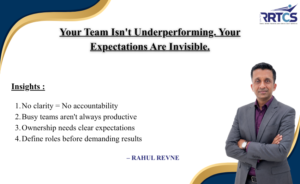
Your team isn’t underperforming. Your expectations may simply be invisible. Clear roles create accountability, ownership, and better performance.
Many business owners often say:
- “My team is not performing.”
- “Employees don’t take ownership.”
- “Nobody is accountable anymore.”
But before blaming your team, ask yourself one simple question:
Have you clearly defined what good performance actually looks like?
Because the truth is, people cannot be accountable for outcomes that have never been clearly defined.
Hiring Is Easy. Defining Roles Is Hard.
Many businesses hire employees simply because there is a requirement.
Sales are increasing, so they hire a salesperson.
Marketing work is growing, so they hire a graphic designer.
Operations are becoming difficult, so they hire an executive.
But nobody stops to answer one basic question:
What exactly is this person supposed to do?
There is no proper Job Description.
- No clear Job Profile.
- No defined responsibilities.
- No measurable expectations.
Employees simply receive tasks whenever a requirement arises.
And over time, confusion becomes the working culture.
When Expectations Are Invisible, Confusion Becomes Inevitable
This is where most businesses unknowingly create problems.
Sometimes, three people are doing the same task.
Sometimes, nobody is doing it because everyone assumes someone else will.
People start working reactively instead of proactively.
Employees remain busy throughout the day, but at the end of the month, nobody can confidently answer:
“What exactly did I achieve this month?”
Not because they are incapable.
But because nobody told them what success actually looks like.
Imagine This Situation
A graphic designer is told:
“Prepare some designs.”
But no one explains:
- What is the purpose of the design?
- Who is the target audience?
- Which platform will it be used for?
- What outcome are we expecting?
- What does a successful design look like?
Without clarity, employees will make assumptions.
And assumptions always create rework, frustration, delays, and disappointment.
The Hidden Cost Is Bigger Than You Think
Unclear expectations don’t just affect productivity.
They slowly damage people from within.
Employees begin to lose confidence.
Their morale goes down.
Ownership disappears.
They start doubting themselves.
Eventually, they stop taking initiative because they fear doing the wrong thing.
And then management labels them as “underperformers.”
But in many cases, the real problem is not the employee.
The problem is the absence of a system.
Every Role Must Answer Four Questions
Every employee in your organization should know:
- What exactly am I responsible for?
- What are my daily, weekly, and monthly tasks?
- How will my performance be measured?
- What outcome is expected from my role?
If these four questions remain unanswered, performance discussions will always become emotional instead of factual.
Stop Managing Through Assumptions
Businesses cannot grow on assumptions.
People cannot perform without direction.
And accountability cannot exist without clarity.
If you want a high-performing team, don’t start by demanding better performance.
Start by defining better expectations.
Because your team may not be underperforming at all.
Your expectations are simply invisible.
And invisible expectations will always create visible problems inside a business.
_________________________________________________________________________________________
Author Bio
Mr. Rahul Revne Founder of RRTCS (Rahul Revne Training & Consultancy Services), Mr. Rahul Revne brings over 15 years of experience in HR, Sales, Strategy, and end-to-end business consulting.
Known for turning struggling ventures into thriving enterprises, he helps entrepreneurs master the art of meaningful customer connection, emotional intelligence in sales, and purpose-driven business growth. Author of Entrepreneurial Series and Spirit of Inspiration, Mr. Revne continues to empower leaders with clarity, courage, and customer focus.