
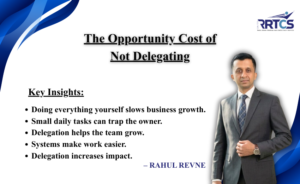
Many business owners believe that doing everything themselves ensures quality and control. In the early stages of a business, this approach often works because the founder is deeply involved in every function.
However, as the business grows, not delegating becomes expensive — not in salary, but in opportunity cost.
Opportunity cost is the value of what you give up when you choose one activity over another. For business owners, this means that every hour spent on tasks others could handle is an hour not spent on activities that truly drive growth.
When the Owner Becomes the Bottleneck
Without delegation, owners often get trapped in day-to-day operations:
- Administrative work
- Small operational issues
- Internal coordination
- Routine problem-solving
These tasks consume time and energy that could instead be used for:
- Meeting new clients
- Building partnerships
- Strategic thinking
- Expanding the business
Over time, something ironic happens — the owner becomes the employee of their own business.
The business cannot move without them, and growth becomes limited by their personal bandwidth.
Why Many Owners Don’t Delegate
Most founders hesitate to delegate because of three common fears:
- Fear of losing control
- Doubt about the quality of work
- Habit of doing everything themselves
But this mindset often creates the very problem they want to avoid: a business that depends entirely on them.
The Real Cost of Poor Delegation
Not delegating affects the business in several ways.
- Lost strategic focus
Leaders spend time on low-impact tasks instead of focusing on growth and strategy. - Underdeveloped teams
When responsibilities are not delegated, employees don’t get the chance to take ownership and grow. - A business that cannot run without the owner
Every decision and task flows through one person, creating bottlenecks and limiting scalability.
Systems Reduce Owner Dependency
To delegate effectively, businesses must rely on systems rather than the owner’s constant involvement.
Documenting simple processes for sales, operations, customer service, and finance creates clarity and consistency. When systems exist, team members can execute tasks confidently without escalating everything to the owner.
This shifts the owner’s role from operational firefighting to strategic leadership.
Three Simple Steps to Start Delegating
- Identify tasks that don’t require you
Operational and administrative tasks can often be handled by others. - Set clear expectations
Define goals, deadlines, and quality standards so tasks can be completed independently. - Build trust with your team
Empower people, support them, and allow them to take ownership of responsibilities.
Delegation is not about losing control.
It’s about multiplying your impact through people and systems.
If a business cannot run without the owner, it cannot truly grow. And the longer delegation is delayed, the higher the opportunity cost becomes.
A strong business is not built by doing everything yourself.
It is built by creating systems and people who can run it with you — and eventually without you.
If you want to understand the bottlenecks in your business and identify what is slowing down your decisions, book your Founder Audit today.
Why RRTCS?
At RRTCS – Rahul Revane Training & Consultancy Services, we help entrepreneurs implement the Profit First framework in their businesses:
✅ Designing KPI-driven financial dashboards
✅ Identifying profit leakage points
✅ Creating SOPs for expense control
✅ Training teams to think “Profit First” in every decision
Because real growth does not come from bigger sales alone —
it comes from better profits.
👉 With RRTCS, you do not just earn more — you save more as well.