
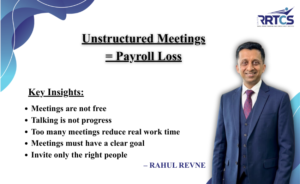
Meetings are meant to move work forward.
But in many organizations, meetings have quietly become a hidden drain on productivity and payroll.
Instead of being tools for discussion and decision-making, meetings often turn into long conversations where ideas circulate but little actual work gets done afterward.
The result?
Employees spend hours talking about work instead of doing the work.
And every one of those hours is paid for.
Meetings Should Lead to Decisions
A meeting should exist for two clear reasons:
- To clarify a problem
- To make a decision
Once a decision is made, the real work should happen outside the meeting — execution, implementation, and progress.
However, what happens in reality is often the opposite.
Teams spend most of their time discussing, debating, and revisiting the same topics, leaving little time for actual implementation.
Discussion can feel productive, but execution is what produces results.
The Hidden Cost of Meetings
Most businesses track expenses like rent, marketing budgets, and software subscriptions.
But very few calculate the cost of meetings.
Let’s take a simple example.
If an employee earns ₹40,000 per month, the annual salary cost is about ₹4,80,000.
That translates to roughly ₹230–₹250 per working hour.
Now imagine a meeting with 10 employees.
A single one-hour meeting costs the organization around ₹2,500 in salary expenses alone.
And this still doesn’t include:
- Management salaries
- Opportunity cost of delayed work
- Productivity loss from interruptions
If such meetings happen several times every week, the cost quietly turns into lakhs of rupees every year.
In simple terms:
Meetings are not free.
They are paid conversations.
The Productivity Problem
Too many meetings also reduce the time available for focused work.
Employees need uninterrupted time to:
- solve problems
- design solutions
- write code
- plan strategies
- complete tasks
When calendars are filled with meetings, people are forced to rush real work between meetings or complete it after hours.
Frequent meetings also break concentration. Each meeting requires employees to mentally switch contexts, which reduces focus and efficiency.
Over time, excessive meetings act like a productivity tax on the entire organization.
Why Many Meetings Fail
Most meetings fail not because the topic is wrong, but because the structure is missing.
Common problems include:
No clear agenda
Without a defined agenda, discussions drift without reaching a decision.
Too many participants
When too many people are invited, most become silent observers instead of contributors.
Dominating speakers
Sometimes only the loudest voices dominate the conversation while valuable ideas remain unheard.
No actionable outcome
Many meetings end without clear decisions, responsibilities, or deadlines.
It could have been an email
Status updates and announcements rarely require meetings.
When people realize the discussion could have been handled in a message or email, the meeting feels like time taken away from real work.
The Real Rule of Meetings
A simple rule can dramatically improve meeting culture:
If a meeting does not create clarity, decisions, or action — it should not happen.
But there is another rule that many organizations ignore.
Every meeting must have a fixed time limit.
For example:
- Discussion meetings: 20–30 minutes
- Planning meetings: 30–45 minutes
- Decision meetings: 15–20 minutes
When meetings have no time boundary, discussions naturally expand.
To maintain discipline, teams can introduce simple accountability rules. For example:
- Meetings automatically end at the scheduled time.
- If a meeting runs longer, the organizer must explain why or schedule a follow-up with a smaller group.
These small structures help teams respect time and stay focused.
Before You Call a Meeting, Ask These 3 Questions
Before scheduling a meeting, ask yourself:
- Is a meeting really necessary?
Could this be handled through an email, message, or shared document? - What decision needs to be made?
If there is no clear decision or outcome expected, the meeting may not be needed. - Who actually needs to be there?
Invite only people who are directly involved in the discussion or decision.
If these three questions cannot be answered clearly, the meeting will likely waste time rather than create progress.
Meetings should accelerate progress, not create the illusion of progress.
When meetings are structured properly, they help teams align, solve problems, and make decisions faster.
But when they are unstructured, they quietly drain time, productivity, morale, and payroll.
And that is why unstructured meetings are not just inefficient — they are a payroll loss.
If you want to understand the bottlenecks in your business and identify what is slowing down your decisions, book your Founder Audit today.
Why RRTCS?
At RRTCS – Rahul Revane Training & Consultancy Services, we help entrepreneurs implement the Profit First framework in their businesses:
✅ Designing KPI-driven financial dashboards
✅ Identifying profit leakage points
✅ Creating SOPs for expense control
✅ Training teams to think “Profit First” in every decision
Because real growth does not come from bigger sales alone —
it comes from better profits.
👉 With RRTCS, you do not just earn more — you save more as well.