
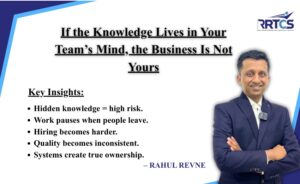
RRTCS has analysed this pattern while working with many businesses across industries, and one critical truth keeps appearing:
If your business knowledge exists only in your team’s memory and not in documented systems, you don’t own the business — your employees do.
The Hidden Risk: Undocumented Knowledge
In many companies:
- No processes are written
- No SOPs exist
- No record of key clients and their importance
- No notes on client behaviour, preferences, or decision patterns
- No supplier communication history
Everything runs on memory and personal experience.
It works — until the day it doesn’t.
This creates a single point of failure inside the business.
The Moment a Key Employee Leaves
The real risk becomes visible when one key person:
- resigns
- goes on long leave
- becomes unavailable
Suddenly:
- Work stops
- Clients don’t get responses
- Follow-ups break
- Supplier relationships weaken
- New opportunities are lost
- The team becomes confused
And the most dangerous loss: client trust.
At that moment the owner realizes:
“The business was not running on a system. It was running on a person.”
Ask Yourself These 5 Strategic Questions
Think about your most critical employee and ask:
- If they stop working tomorrow, what will happen?
- Do you know what they are currently working on?
- Which clients are directly dependent on them?
- What is their exact process for handling work?
- Can someone else immediately take over their role?
If your answer is “No” to these,
your business is in high operational risk.
Person-Dependent vs System-Driven Business
|
Person-Dependent |
System-Driven |
|
Knowledge in people’s minds |
Knowledge in documents |
|
Work stops when someone leaves |
Work continues smoothly |
|
Owner feels stressed |
Owner has visibility |
|
Growth is limited |
Business is scalable |
A person-dependent model is not a business — it is a fragile structure.
What Should Be Done?
1. Build a Knowledge Capture System
Sit with your key team members and document:
- Step-by-step processes
- Key client list with weightage
- Client behaviour and communication style
- Pricing logic
- Negotiation approach
- Common problems and solutions
This is not just documentation —
this is your business DNA.
2. Create SOPs for Every Repeat Task
Document procedures for:
- Sales process
- Client onboarding
- Order execution
- Complaint handling
- Payment follow-ups
So that any trained person can run the function.
3. Develop a Client Intelligence Sheet
For every key client, record:
- Decision maker
- Buying triggers
- Payment pattern
- Communication preference
- Last discussion summary
This strengthens relationships beyond individuals.
4. Create Role Backup (Shadow System)
For every critical role:
- Assign a primary owner
- Assign a trained secondary backup
Your business should never stop because of one absence.
5. Weekly Knowledge Transfer Meetings
A 30-minute weekly session where team members share:
- What they are working on
- New learnings
- New risks
- New opportunities
This builds future leaders and reduces dependency.
6. Owner-Level Strategic Visibility
The owner does not need to do everything —
but must have visibility into everything.
Maintain a simple dashboard showing:
- Active deals
- Key client status
- Pending payments
- Major operational risks
The Most Dangerous Sentence in Business
“Don’t worry, he will handle it.”
That sentence creates dependency,
and dependency kills scalability.
Your Real Business Asset
Your real asset is not your office, team, or product.
Your real asset is:
documented knowledge + defined processes + structured data.
The day your business runs smoothly without depending on one person,
you move from being an operator to becoming an owner.
Final Strategic Truth
If knowledge lives in your team’s mind,
control is not with you.
When knowledge lives in systems and documents,
the business truly becomes yours.
📩 Connect today to start building your systems.
Book a Founder Audit to identify your business bottlenecks.
Why RRTCS?
At RRTCS – Rahul Revne Training & Consultancy Services, we help entrepreneurs implement Profit First frameworks by:
✅ Designing KPI-driven financial dashboards
✅ Identifying profit leakage points
✅ Building SOPs for expense control
✅ Training teams to think “Profit First” in every decision
Because real growth is not about bigger sales —
it is about better profits.
👉 With RRTCS, you don’t just earn more — you keep more.